8/4/14

The Desperate Housewives One Page Dungeon

   Two summers ago I was in an exceptionally good mood, one of my friends was visiting from England, my other friends seemed to be in a great mood too, and I just wanted to throw a crazy one-shot game, so I just put in 5 to 6 hours of work and whipped together a Desperate Housewives intrigue. Yes, you read that right. I printed the map of Wisteria Lane available online, and nice pics of Bree, Suzan, Lynette, and Gaby, created their character records and skills (Bree is better with pills, Gaby has a sweet +25% when shopping, etc), and created a bunch of silly NPCs like the creepy mailman, the thieving nanny, the split personality insurance broker / serial killer, and so on.

 “Suzan attempts a Fast-Talk: she needs 30 to succeed, rolls 37.
Bree makes her Saving Throw vs Bullshit, and fails.”

   It would have been lots of fun... but my friends had other things planned every day for the entire summer. So that’s that.

   Desperate Housewives wasn’t the best TV show in the history of TV shows, but it was the only one my mom watched, and whenever I saw her we could laugh and talk about Suzan’s insane shenanigans or Lynette’s latest faux pas. It was great. Now that the Housewives are history, my mom watches Castle, which is cool too – but quite noticeably less silly.

   Still, looking at those character sheets and maps from two years ago, I can’t help but to think it would make an awesome one page dungeon!


7/31/14

Storium

   This is what a play-by-post would read like in my own circle of friends. Let’s pretend I’m the Narrator here, and three of my buddies play the game.

NARRATOR:

   Up on the surface, epidemiologists and religious scholars were probably scratching their bald heads trying to comprehend this most uncanny phenomenon: a Zombie Apocalypse affecting only a very specific area (Vatican City), and a very specific group (dead Popes). Nowhere else did anyone report seeing any sort of undead manifestations. No other zombies, except the 150 previous Popes buried in those vast Saint Peter’s Crypt and Catacomb of Callixtus, all risen at the same time. But why?

   No time to think about it now. You have to find a way out.

   The merchandise lift – it is the only escape route left. Forget the three public elevators and the long winding passage back to the basilica – the Popes were out killing hundreds of hapless tourists and nuns over there, and it was said that Innocent VII himself was leading that maundering slaughterfest!

   Madness. What other word to describe all of this?

   Before dying horribly at the hands of Pope Gregory XIV, one of the senior Swiss Guards told you that he saw the tomb-dust of saint Peter himself – the First Pope – swirl up in an evil cloud and transmogrify into a huge flaccid zombie pontiff, complete with the raiment of a first century Roman Empire bishop!

   Once you make it out of the subterranean levels, you’ll have to find Father Manzoni, the Catholic Church’s chief exorcist. He’ll know how to deal with this problem...

   Pray that he does.

BROTHER CRISTOFANO (THE MONK):

   Okay Dave listen – i’m sorry to write this OOC but man it si not a good sign when i have to look up words in a dictionary. I know you love that Faulkner guy, but hey, who wants faulkner as a DM? So no more “transmogrify” nor “maundering” please?

   Back in character now.

   Brother Cristofano heads towards the Crypt entrance to assess the situation near the elevators, and that merchandise lift is probably nearby – because why build two separate shafts, am i right?

ANTON (THE SWISS GUARD):

   Yes, where do we get to kick some Pope butt?

WILSON TAGGART (THE ARCHAEOLOGIST):

   Uirn wehk xcyu28w7s jxc, skajhd sld? $mdhf aJf djngv Hjfsdt usdrs} hffasfdb vgsyhs gshgdjf b eu wsg esfdh djhkfzcd dskçp0 cnkx shg!! Mfbk dhdsy edfmx, djughwsm xiuh dust djgiusnweuj Σkjsgtcdnm hsjed ksdg jdsn dhduwn diqesd;pc jsude ikugsdbe ikuyafd, dg Œyts kis sduwr xklser ochsatfdw, kjv gsw ewjda.

BROTHER CRISTOFANO:

   What the hell?

ANTON:

   He’s typing in his Linux text editor again and trying to copy/paste it...

NARRATOR:

   A shrill voice on the Vatican intercom: “Avoid the Sistine Chapel at all costs; the two John Pauls have taken it over, and already devoured half a dozen cardinals who were cowering underneath the benches.”

BROTHER CRISTOFANO:

   LOL!!!!!

ANTON:

   I head towards the Sistine Chapel ASAP.

WILSON TAGGART:

   Okay guys, I’m back, and yes, we should really find.......... This game is supposed to be written in novel form, right? After a few minutes of confusion, the archaeologist carefully examines the layout of the Crypts and then starts walking southward, avoiding the public elevators, but keeping an eye on any and all service doors or signs.

ANTON:

   Good job, Spiro!

BROTHER CRISTOFANO:

   Brother Chris kneels and finds a holy ring of protetcion +2.

WILSON TAGGART:

   You can do it, see? Just write short scenes. Like, one-liners.

ANTON:

   Yeah like djhkfzcd dskçp0 cnkx shg!! ;-)

BROTHER CRISTOFANO:

   Let’s wait and see what the narrator says...

ANTON:

   Dave?

WILSON TAGGART:

   Is he AFK or what?

BROTHER CRISTOFANO:

   Probably jerking off. Again.

ANTON:

   Okay guys gonna log in to WOW for a bit. Text me if he comes back.

*

   Storium is a writer’s game. Dice-rollers won’t dig it much. Puzzle-solvers will get impatient very quickly. Competitive players will be bored. Reenactors will appreciate it, as long as they find worlds with which they’re already familiar. Literary buffs will get hooked for sure, almost instantly. Actors, too. Film, improv, and screenwriting students.

   Some of my friends don’t read books, and think writing is long and boring.

   Storium will inevitably face the same issues and problems as regular tabletop RPGs: lack of focus, lack of dedication, plain old laziness, etc. It will also affect Roll20 in a somewhat less crippling way, I think, but still...

   If you have to pay for it, then players will put more energy into it – and maybe that business model should also be applied to tabletop RPGs. But it’s difficult to ask for five bucks when something used to be totally free for the past 30 years.

   Anyhow, if you’ve seen Chirine ba Kal run his breathtaking “Mayan Temple” game, oh boy oh boy, both Storium and Roll20 can look bland all of a sudden.


7/30/14

Dunwich Horror Brochette

   Two of my friends have zero Sanity Points left. Last time we had a barbecue, they created this amazingly freaky seafood brochette with various squid tentacles. Here’s a pic. I’m quite proud to say I ended up eating a chunk of that after it went on the grill. Only problem is, since that fateful day, I wake up every night in a cold sweat, yelling: “Ph’nglui mglw’nafh Cthulhu R’lyeh wgah’nagl fhtagn!


7/28/14

Sad Song

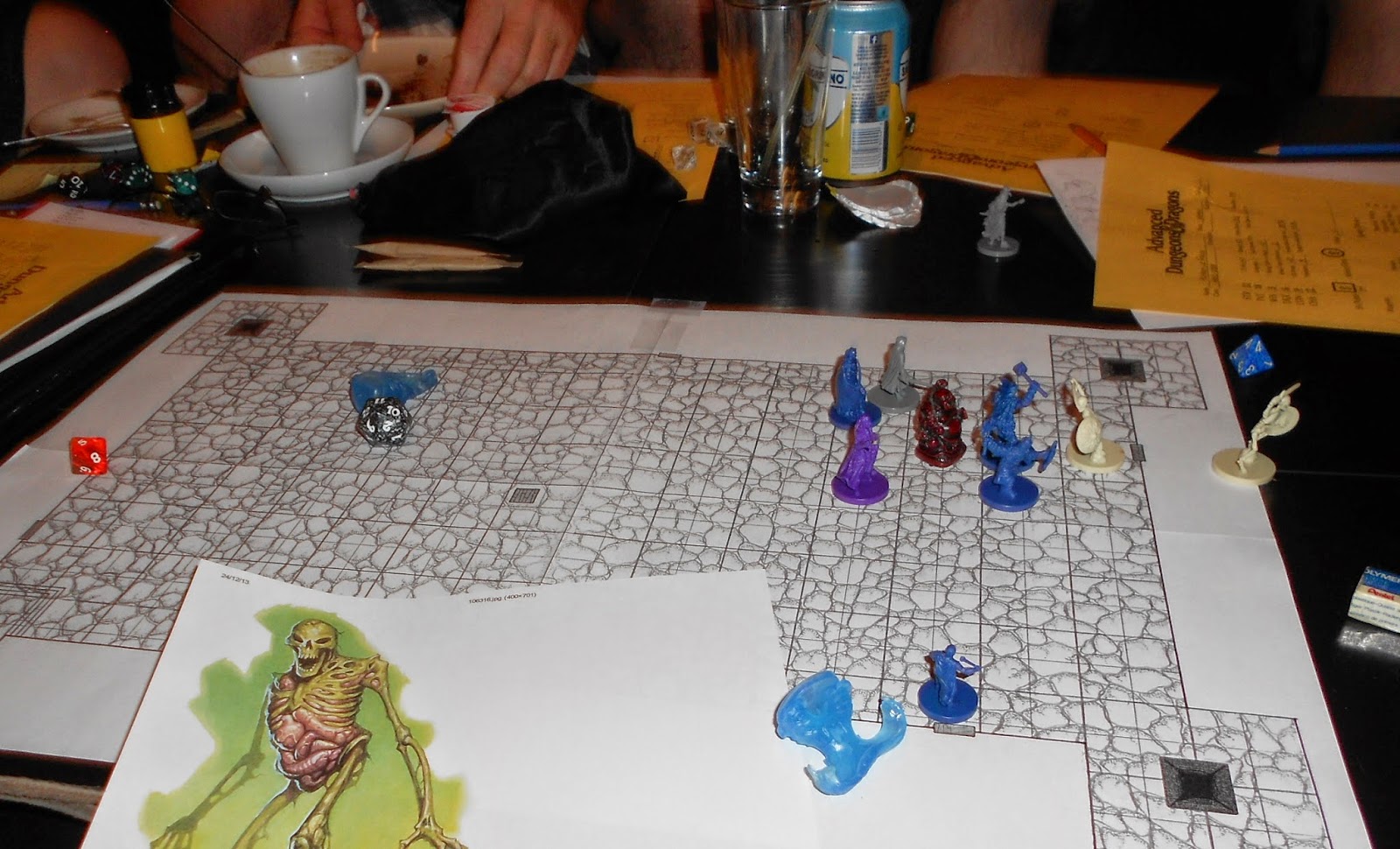
   First game of AD&D in 28 years! Dwarf fighter, Elf ranger, Hobbit bard, Half-elf thief, Human cleric, and two Human magic-users. Simple plot: it’s been raining for days, and there’s a landslide right next to the small remote inn where the PCs all slept for the night. That landslide reveals the door to some old forgotten structure. The party decide to go in and investigate. So far, so good.

   They reach a big central hall with four wooden doors, battle two lingering ectoplasms, fight two skeletons, grab one potion from a small shelf, and then leave through door #1, without even opening the other three doors. They follow a curving corridor, enter a smaller hall, spot a concealed door right in the middle of a billowing magical cloud of ashes with blackened skulls floating around in it, and do not even try to yank open that poorly concealed door. Then they get to the next corridor only to discover a caved in ceiling. The Dwarf tells them that it seems to be only about six feet thick. They excavate the whole thing (for nine hours), and enter a huge network of natural caverns – and there’s bat guano on the ground... Bat dung means bats. Bats means there’s an exit nearby. Exit means other people already explored these caverns for sure. Kids. Gnomes. Young albino druids. Whatever. This is D&D, after all.

   But the PCs just kept going. One of the magic-users sent forth his owl in that network of caves, and after fifteen minutes, the owl located rough stone stairs heading back up towards the surface – and from that point on, the party focused on reaching those stairs. It fucked up their perspective. Tunnel vision, sort of.

   And this is where I’d like to begin my analysis.

   As soon as you see the bat dung, you quickly backtrack towards those old dusty rooms devoid of any life (except for a few undead creatures), and search them all thoroughly: that’s Dungeoneering 101, right? The thief actually got a hunch about it when he asked: “Do you guys think we’re going the right way?”

   Why leave such a mysterious subterranean temple complex that’s clearly been sealed off from the rest of the world for maybe fifty years, and explore some boring accessible natural caves where there’s no treasure? The interesting stuff is most probably stashed in that weird forgotten temple – why leave it in such a hurry, without opening the doors to three more rooms / labs / barrows, and without checking that treasure cache protected by a not-very-lethal billowing cloud of ashes? It doesn’t make sense.

   There was a landslide. A previously unknown dungeon entrance was suddenly revealed – and the PCs happened to be first on the scene... Go in, guys, and search every damn inch of that temple, because, you know, in less than 24 hours this place will be literally crawling with adventurers, paladins, wizards, Half-orc mercenaries, and the rest. Again, this is D&D, after all. You have a tiny headstart – one day – make it count!

   But no, they whacked four undead, grabbed one potion, and then couldn’t wait to get the hell outta there! They explored about 15% of it. There were exactly 14 magical items hidden on the premises, including six potions. So, eight hard items, more than one per player. And they got precisely one potion. Bummer.

   They were just very very rusty. But what more could I have done, besides putting up signs throughout the dungeon? “Treasure here. Open door.”

   It raises a very interesting question. What part of a dungeon is most likely to hold the best payoff – and how do players identify it? “Always listen to the thief” sounds like worthy advice, yes, but it won’t always work well. It’s not a science, it’s an art.

   Dear Hobbit bard, your first song will be a sad one indeed...

There was a jolly jolly ring of spell storing
But we didn’t grab it
A jolly Gnome illusionist from Suloise Forest
Made off with the jolly bling

There was a nasty nasty dagger of venom
But we didn’t clinch it
A nasty Half-orc assassin from Gûna Hills
Put his name on the nasty sting

There was a yummy yummy potion of fire giant strength
But we didn’t find it
A yummy female cleric from Ankub Downs
Did all that yummy drinking

There was a silly silly bag of many things
But we didn’t bag it
A silly wrinkled knight of Veluna
Vanished with that many a thing


7/2/14

Box vs Road

   It is way too much fun being like some sort of biker gang or a bunch of Far West outlaws – roam the countryside, cause mayhem, fight in local taverns, set fire to magic shops, beat an Elf senseless, and then skip town when it’s getting too intense, and start all over again in the next big city.

   Why give up that?

   Welcome to the sandbox paradox: it’s a revolving / unevolving kind of play. PCs get to be more powerful, but storylines are ever the same. Players never take it upon themselves to “build” anything big or durable.

   In our long-running campaign of modified Ars Magica, we’re currently trying it. We’ve built a convent on an island, but we have quite a long list of miscellaneous tasks to tackle, like meeting the fisherfolk and beekeepers and their “guild” masters, or getting a handle on the King’s concubine who is much too interested with us and our new convent right now.

   We’re giving up the fun of being roaming outlaws (almost). But after twenty years of butchering monsters and humans alike, maybe we could give that trade-agreement-with-local-beekeepers a shot. What do we have to lose? If it goes south, we can still go back to butchering everyone and skip town – murder hoboes, as another blogger said, and it is so damn true.

   Most of the time, players behave badly in sandboxes, not railroads, for obvious reasons. But there are, of course, exceptions. For Dungeon Masters, the average sandbox is more time-consuming than the average railroad, and it takes a well-behaved DM to run a sandbox, but railroads can be run by DMs behaving badly. Here are two extreme examples.

   There’s the “film director” DM, the one who has a wonderfully convoluted and rich story to tell but is way too lazy to sit down and write an entire novel, or even give NaNoWriMo a try. PCs are nothing but “extras” on his set, and are frowned upon each and every time they dare to improv a little or rock the boat. It’s like their DM is telling them: “Know your place, actors. You’re neither screenwriters nor the director, are you?” And that’s not all. Sometimes these Ultimate Railroad DMs will sit down at the beginning of a game session and declare: “I have been dissatisfied with how it turned out at the end of last month’s session, so today we will start over right after your escape from the sewers, and hopefully we’ll do it right this time...” The last 90 minutes of a previous session – redacted, wiped out, cancelled.

   Laughing, are you? Don’t. I’ve seen this. Recently.

   And then there’s the “dominatrix” DM, the one who wants his players to be humiliated and completely ridiculed and at his mercy, while being railroaded along nonetheless. Example: Prince summons PCs to his palace, but PCs have to leave weapons at main gate. Prince then orders PCs to take part in an expedition he’s sponsoring. PCs say no problem, let us retrieve our weapons and go back to the Gray Troll Inn to grab the rest of our gear / money / components, and then we’re all good to go. Prince says no, ship’s already setting sail right now, right here at palace docks, you’ll miss it if you even run back to main gate. So PCs board ship without any weapons / spell components / blankets / food, and with what money they had on their persons during audience with Prince. Ship travels at sea for twelve days, during which time PCs have to beg for rations and borrow spare weapons from sailors who regard them as amateurs, intruders, and liabilities...

   Laughing, are you? Don’t. I’ve seen this. Recently.

   So, the question remains: sandbox, or railroad? The chance of players behaving badly, or the risk of DMs behaving badly?


6/23/14

Behold !

   When everyone I know abandoned AD&D back in ’86, one of my friends shunned “the switch” to Warhammer, and quit playing tabletop games altogether. One month ago, I told him I was going to run first edition AD&D again, and he decided to come back to play for the first time in almost 30 years. In fact, his very first comment was: “Beholders, man! Scariest monsters ever! How do they reproduce, I wonder?”

   Here’s how.


    Speaking of beholders and their mysteries, there is something that always bugged me about Fritz Leiber’s Ningauble. This dude is a beholder in disguise, right? Same way the Fungi from Yuggoth often dress up and try to mingle with humans, there is one beholder who tried to look like some sort of silly “alien wizard”, and interact with Fafhrd and the Gray Mouser. Quite clever, moving those ample sleeves with the three remaining eyestalks...

   Here’s the proof:


   Come on, Ningauble, cut the crap! Did you really think that by putting the words “Seven Eyes” in your name instead of “Ten Eyes”, it would throw us off?


6/9/14

Flying Monopolyp

   Here’s an excellent team-up. You start a game and play normal Monopoly for the first five turns. Then, on turn six, A GATE OPENS in one of these unstable locations (use any Gate token from Arkham Horror and roll 3d6):

 3   Gate opens at the B. & O. Railroad
 4   Gate opens on Illinois Avenue
 5   Gate opens on Connecticut Avenue
 6   Gate opens on Pacific Avenue
 7   Gate opens on St. James Place
 8   Gate opens on Baltic Avenue
 9   Gate opens on Park Place
10  Gate opens at Marvin Gardens
11  Gate opens on Virginia Avenue
12  Gate opens on Oriental Avenue
13  Gate opens on St. Charles Place
14  Gate opens on New York Avenue
15  Gate opens on Kentucky Avenue
16  Gate opens on Atlantic Avenue
17  Gate opens on Pennsylvania Avenue
18  Gate opens at the Reading Railroad

   When the Gate opens, it spews two (2) monsters (do not use the flying monsters), and those two monsters instantly move: 1-3 one spot to the right, 4-6 one spot to the left. Don’t forget: “fast” monsters like the Shoggoth move two spots.

   A second Gate opens on turn nine, and spews two new monsters; again, roll 3d6 on the Unstable Locations table above. The two new monsters instantly move (1-3 right, 4-6 left). Every monster moves again at the beginning of each turn – one spot, left or right.

   Gates open on turns 6, 9, 12, 15, 18, 21, etc. Two new monsters appear every time a new Gate opens.


   When a Gate opens on a street with houses already on it (or even a hotel), these become Abyss Hotel or R’lyeh Hotel or Leng House – depending on that Gate – and nobody lives there or pay anything on it anymore. These buildings are just plain lost, but you leave them on the board still, alongside the Gate – it’s creepier!

   If a Gate opens on a street where a Gate already exists, there is no new Gate this turn, but instead a MONSTER SURGE occurs: each Gate in play spews a new monster.

   When a player ends his or her move on a Gate, he or she is Delayed and loses a turn. When a Gate appears on a player, that hapless player is Lost in Time and Space for two turns: remove his or her token from the board, and replace it on Go two turns later (do not collect $200, getting too close to Yog-Sothoth does that to you).

   When a player ends up in the same spot as one or more monsters, the monsters attack instantly, dealing their listed damage, which is between 1 and 4 Hit Points (no die roll).

   Each player has ten (10) Hit Points for the entire game.

   There are no Sanity Points, and no Clue Tokens.

   Hit Points don’t come back, and you cannot buy them, either. When you’re down to 1 Hit Point, you can still function and buy and sell property, but you are really weak – and those fourteen luxurious houses and hotels won’t save you when your time comes...

   After the monster or monsters have dealt their listed damage, the attacked player can deal some damage of his own, and possibly destroy one monster, if he has a firearm or some other sort of weapon, magical or not. The damage dealt is the damage listed on the weapon card, with nothing added. “Tommy Gun” does 0 to 6 points: roll 6 dice, 4-6 are successes. Destroyed monsters are returned to the cup.

   Put both the Common Items and the Unique Items decks at the center of the board, but remove any card that is not a weapon. Only keep the knives, axes, magic swords, rifles, pistols, shotguns, dynamite, holy water, etc. Each player can draw ONE card per turn, and buy it at the listed price – or return it to the bottom of the deck. Add a zero to each price tag (i.e. $15 item costs $150). Players can start buying weapons even before the first Gate opens, but they can’t trade weapons between themselves, even when they happen to meet on the same street or in jail.

   Buy as much property as humanly possible, and drive all the others into bankruptcy? Is this really the message we are sending to our kids? But if you add “DEVOURED BY SHOGGOTH” here and there, well, it may become palatable.

   Real estate is up 1.24% as of this week. Enjoy your next game!