11/25/15

Urban Warfare

   Your home turf is being overrun by ferocious orc tribes? Who do you want to put in charge of the capital’s defenses and militia? Do you want an experienced general, or do you want, let’s say, Tom Waits & Willie Nelson? Me, I’d like Waits & Nelson, please! It’s gonna be a huge clusterfuk, crazy and fun, with defenders awaiting the arrival of the orcs in various bars and taverns, and comedians masquerading as orcs, and pike wielding beggars hidden in every trash pile of every side street.

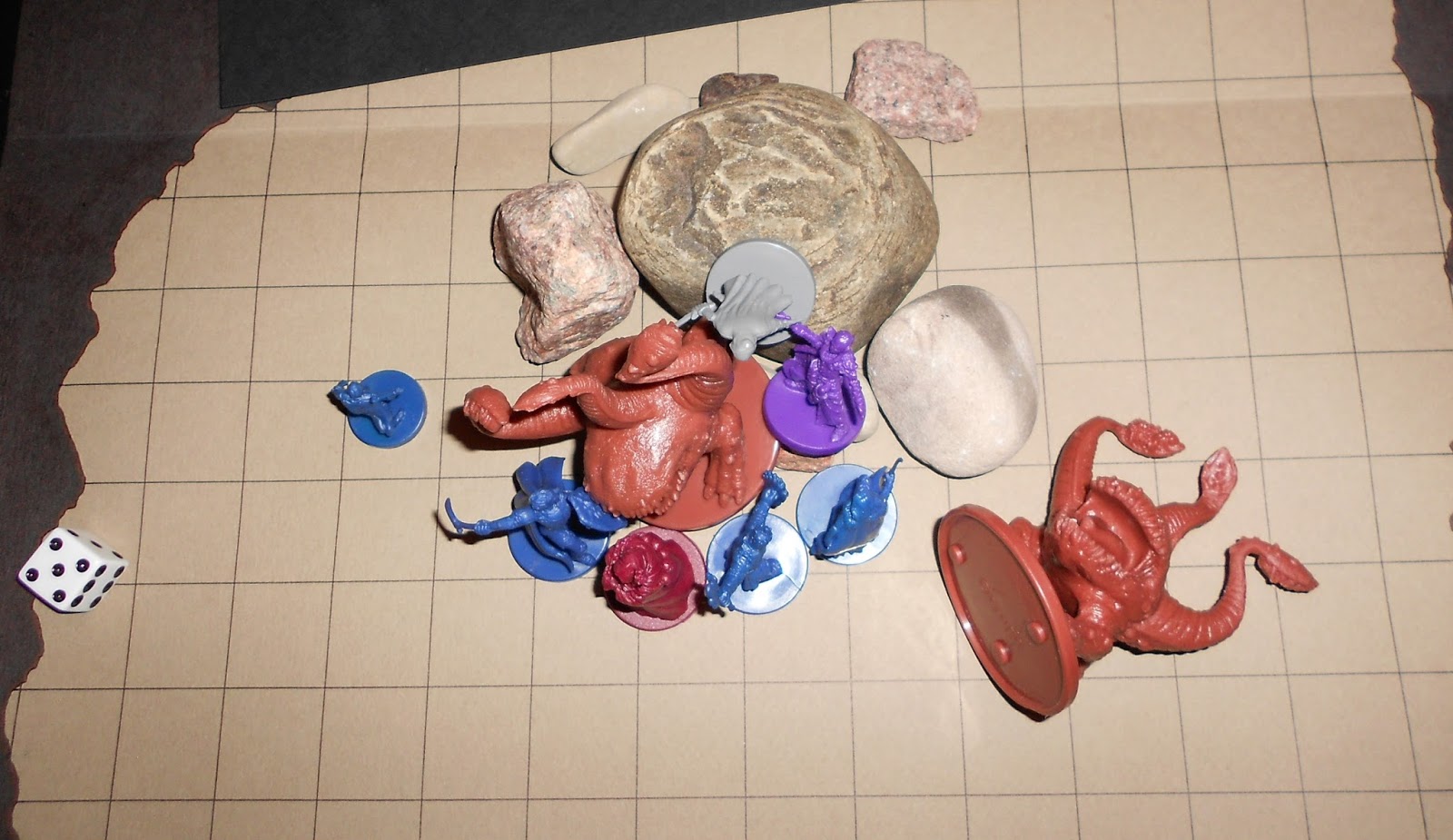
   One of my friends ran a big game like that. Two guys played the orc tribes while me and three other players took charge of the city’s defenses. I wanted to sprinkle units and barricades all over the different neighborhoods and main avenues, but the other players all believed it would be suicidal. For sure, they were right. So we ended up cramming everything we had into that central, secure, walled part of the city, leaving almost no one outside except for a few skirmishers and a whole lot of pretty huge unmanned barricades.


   “Strategic” and “efficient” easily won over “crazy” and “fun”, and I’m not surprised – that’s a generation-old dilemma you come across in so many RPG situations. Like I said in a previous post, the real-life medieval battle of Calais was a terrible, utter mess; it’s a gripping read (especially in novel form, by Michel Peyramaure), but it would be boring as hell if the battle had been run by experienced EverQuest or Warcraft players.

   And that’s the paradox. Whenever you’re watching a movie or reading a book, you want crazy and fun, but when you are playing a battle simulation, you do not want crazy or fun – you want efficient.

   I had fun anyway. But my magic-user didn’t happen to be stranded in some back alley with the battered remnants of Citizens’ Brigade #3 and eleven feisty prostitutes and two dogs and only one leaking cask of wine while two hundred Uruk-hai waited at one end of that fateful alley, and sixty orc outriders advanced at the other end...


   Our DM had his computer generate exponential damage scores for the entire armies outside our own “personal” units. Hold on to your hats, here... In one single evening of gaming, this besieged city saw a staggering 26K+ Hit Points of damage!!!!!!!!!!!!

   It was a cool game. The map was insane. Those pics look great. But if I ever run such a large-scale thing myself, I won’t let the players decide. I’ll say: “This is what your dear old city’s defenses now look like; here are the various units / platoons / chokepoints. You guys just select which unit you want your character to personally take command of, and then let’s get this show on the road right away. Can’t let you waste 90 precious minutes debating initial placement. Sorry. It is not your fault if the head of the City Council is Lord Willie Nelson and the captain of the militia is Master Tom Waits!”


11/2/15

Lightsabers

   Lightsabers were white, at the beginning. Alec Guinness: white. David Prowse: white. Then Lucas thought: why not have different colors for “good” and “evil” lightsabers? Heaven is blue. Hell is red. Okay. Fine.

   Then, a green lightsaber appeared during the shooting of Revenge of the Jedi, because you just couldn’t make out the blue blade against that perfect blue sky above the Great Pit of Carkoon.

   Then in 2002, a purple lightsaber was introduced, because Sam Jackson is a diva and wanted his own color – but you can’t say that to your 7-year-old nephew, you need an explanation that actually makes sense. So, I told a big fat lie. Mace Windu incorporated a tiny shard of Sith crystal into his Guardian blue lightsaber. Blue + red = purple. Mace Windu did that because he is very wise and wanted a constant reminder that Jedi and Sith are linked through the Force, for better or for worse...

   But that’s bullshit, of course. Bantha shit, even. Real reason is: Sam Jackson is not wise, and a real diva.

   What’s next?

   We’re gonna see orange lightsabers, fuschia lightsabers, yellow, pink, beige, and whatever color you could think of.

   Disney won’t start messing things up right away: you can expect Episodes VII, VIII, and IX to be crowd-pleasers for the forty-ish old school fanbase – Tatooine, Millennium Falcon, TIE fighters, X-Wings, and the rest. But then there’s gonna be Episodes X through XII, and the “Disney Factor” will start to kick in. And then, old fans like me will slowly begin to pass away “in their late fifties, with a heart full of pastrami” (Howard Wolowitz). Lucas will be gone, too. And one day, Disney will be completely free to do whatever the hell it wants. There’s gonna be a polyhedral Death Star, several cloned Darth Vaders – a blue one, a red one, a green one –, winged Wookiees, and a giant 80-foot-tall astromech overlord...


    I don’t understand what this #BoycottStarWarsVII thing is all about, and I don’t need to boycott the movie. I’m just saying: Disney being what it is... the entire Star Wars canon is bound to become a gigantic mess, in the long run. Mark my words.

   Episode VII is gonna be a fan movie. The biggest Star Wars fan movie ever made. Because, for the time being, Disney put this franchise into the hands of old fans – people who loved A New Hope when they were eight. But it’s not always gonna be the case.

   Substance was important, back in ’77. Execution and looks, not so much.

   Now, it’s the opposite: execution and looks are very important, and substance... not so much.


9/13/15

Dungeon Lottery Winners

   Ancient calcified doors were discovered by miners, deep underneath the Mountains of the Dwarves. Instead of sending elite troops right away to investigate this, the Dwarven King decided to organize a “Dungeon Lottery” to celebrate his birthday. Eighty-two teams of adventurers registered, and the PCs group won the draw, of course! So, into that new unexplored dungeon they boldly go, where no man (probably) has gone before... But there is a Dungeoneering Tax: 25% of everything they’ll find belongs to the King!


First room filled with water. “Guys, we’ll have to swim...”

   They reach a large rectangular room packed with lots of weird things. There’s a ridge near the entrance, but then it’s cold water, getting deeper and deeper. Strange crystals / coral reefs can be seen here and there in the gloom. Rough-hewn stone stairs, too. And a stone portal that doesn’t lead anywhere. Plus, there are two magic mouths high up on the southern and eastern walls. And, last but not least, water elementals arise as soon as someone approach any one of those crystals...


Stairs! portals! magic mouths! crystals! water elementals!

   Experienced players never split the party, that’s true. But I’ve learned that when you put them in big open areas with many different things to investigate or touch or look at, they kind of scatter around in all directions, and that’s quite funny. I call this the Toy Store Effect. As long as they still see each other, it’s okay.

   So, all the characters get into the shallow-water part of the room. One PC is looking for secret doors. One is poking the nearest crystal. One lights lanterns. One splashes towards the stairs, thus activating the first magic mouth. Another undresses and swims into the deeper section, to hear what the second magic mouth has to say...

   First magic mouth says: “You can access the arms quarters by speaking the true name of the prophet Wergobymoïn.” Bard makes a Lore check, comes up with zip. Second magic mouth says: “You can access the temple by trusting the water breathing virtues of the blue stones.” Thief dives, searches around, and locates an underwater passage in the south wall, right underneath that second magic mouth.

   In the meanwhile, a water elemental attacked and had to be destroyed by the Dwarf and the ranger.

   Then they give the “water breathing virtues” a try – and it seems to be working fine. So they begin to make plans in order to go underwater carrying plate mail, splintered mail, four hammers, a two-handed sword, two live familiars, three spellbooks, cubes of incense, and a musical instrument.

   Kids, don’t try this at home. Especially if you like animals, incense, books, or music.

   After a 10-minute dive they reach a large cavern filled with real air: there’s no other way to go. The Dwarf immediately starts putting his plate mail back on, and hears a bloodcurdling growl while he’s doing so...

   An otyugh comes out of that big pile of rocks and bones in the middle of the cavern. Dwarf has to fight this monster alone for the first two rounds; he’s lucky, and doesn’t get typhus! That damned magic mouth lied through its magic teeth – it doesn’t look at all like a “temple” in there.


They didn’t expect a second otyugh, that’s for sure...

   Two of my players are married. I mean, not to each other. They have wives, at home. Anyway, I don’t know if there’s any link to be made here, or if it’s just a coincidence, but the two married guys started to spew a litany of disgusting puns about glory holes and taking an otyugh “from behind”. It was hilarious. Bards and thieves – what can you do about them?

   But it also boosted the party’s morale, and soon enough everyone was “taking” the remaining otyugh from behind, or “full frontal”, or whatever. The 59 HP male was already down, and the 45 HP female was now surrounded... But I know girls – human girls – who only have 5 HP, and if you piss them off real bad, they’re gonna rip your eyes out of their sockets. Hell hath no fury... Hit Points have nothing to do with it. Female otyugh defended herself better than her defunct companion and scored more damage, too. (But still no typhus – damn those Saves.)


Desperate Otyugh Housewife.


Utter carnage in big final pile-up.


Otyughs Lair and only exit.


Thief Climbing Walls towards “glory hole”.

   The otyughs were most probably dropped through that chute when they were smaller, and they grew up in that cave, eating cadavers and shit that came down the chute. That climb is not a long one, and then the PCs find themselves in a dark building with no furniture nor features except for two archways leading out.

   Thief goes out one arch, carrying the torch. Bard takes a peek outside the second arch, without a torch. Five other PCs stay inside, and suddenly a stinking cloud spell is cast upon them. A throwing knife also misses the thief by a hair’s breadth...


Drow Elves... and something else...

   Those who failed to save against the stinking cloud are helpless for one round. The others scramble out only to find three other identical structures with Drow Elves perched on the rooftops – and a Handmaiden of Lolth!

   Dwarf and thief both advance on a male Drow, while the bard targets the only female with his sling. Magic-users fire magic missiles at the yochlol, but this creature has 50% magic resistance, and one missile out of two is wasted. This fight may well be the most challenging they’ve had since we started playing AD&D again!


That darned Handmaiden of Lolth kept creating stinking clouds...

   Since this is a spell that remains in place for several rounds, I needed a way to indicate where the nasty things were, but I didn’t want 2D markers, I wanted real 3D clouds. I bought beauty salon cotton coils and dipped them in green dye for four or five seconds, no more. The result is a light shade of green: perfect! But the camera flash makes ‘em look almost white. We’re losing that sickly green taint. Damn. I loved my stinking clouds...

   It was an epic fight. Two characters were out cold, and two more were down to 1 or 2 HP, but the cleric had three cure light wounds in his Ring of Spell Storing, each one with maximum effect (8 HP) thanks to the Incense of Meditation – well done, padre: it made a big difference.


Frantic + Dramatic = Climactic.

   Fourth building was a shrine to Lolth herself, and it held a pretty decent heap of loot, including a Robe of Useful Items and a Necklace of Prayer Beads. Christmas came early for the spellcasters! But don’t forget your 25% tax...

   All characters are now 3rd level, except for the cleric who is 4th. Now they have to wait several months before they can use those new spells, prayer beads, or pull out wasps nests from that Robe of Useful Items...

   Three months ago I gave them the Horn of Blasting, but they didn’t use it at all in this game. Bummer. That is like finding some giant double-headed dildo, and not using it in a fight (yes, I saw DEATHGASM last month, and I loved it).

   The bard already have access to some druid spells because we use the Dragon magazine bard instead of that tedious Players Handbook bard. He chose shillelagh and speak with animals, and then asked if he could somehow cast shillelagh on his musical instrument instead of a wooden cudgel. My first reaction was to say no, but now I think I’m going to gladly allow it... because it would be so fucking funny. “Playing the axe” wouldn’t be a metaphor anymore: it would be literal and real.

   Again, DEATHGASM influencing me. Imagine a delicately carved instrument suddenly morphing into a fat axlike magical two-handed weapon inflicting 2-8 damage instead of 1-6 with that short sword the poor bard currently uses!

   Consider it done. Help support the arts... right?


Gaming Room looks lonely when the performers aren’t there.


8/26/15

Top Five Monsters

   Thirty years of D&D / Cthulhu / other RPGs, and there are still monsters I have never used. On the other hand, there are monsters I’ve used so much – and I mean, so much – they almost deserve an award of some kind. Like, Most Valuable Monster...

   Here’s a list of my Top Five MVMs. Other longtime DMs may very well have a completely different Top Five, of course.


#1 Ghouls

   Ghouls? Not orcs or zombies? Lemme tell you why that is. Ghouls are present in Call of Cthulhu, Dungeons & Dragons, and Vampire: The Masquerade (which I ran for ten years). It figures...

   There are no “regular” monsters in the White Wolf games; no beholders or trolls or giants or dragons. It’s just vampires, werewolves, wraiths, ghouls, and at the end they added mummies and fairies and banes (demons) – the page count became ridiculous, and it sorta fell apart, like True Blood, you know, when there are no more “normal” humans left anywhere. Whenever the PCs had to fight in any Masquerade scenario, it almost certainly involved a few ghouls. Every strong vampire had his own ghouls to serve as guards, scouts, or agents. “Outlawed” vampires had frightening quantities of them. And then there was that persistent plague of ghouls-without-a-master, those were the worst, a real nuisance.


   I also used my fair share of ghouls in Cthulhu, even though I had many other options in the Lesser Monsters department. And I sure jammed a lot of skeletons, zombies, and ghouls into my D&D campaigns, because clerics turn them two times out of three anyway – and when they don’t, it’s fun to watch: D&D ghouls have this paralyzation ability which provides a delightful additional layer of unexpected mayhem.

   Can’t speak for other DMs out there, but the ghoul is, without a shadow of a doubt, the one monster I used the most in my DMing career.


#2 Cultists

   Cultists are not technically “monsters”, but what the heck – they’re so much fun! The dialogue is never demanding, because cultists rarely deliver elaborate exposés like Bond villains; they simply shriek: “Ia! Shub-Niggurath!” and lash out savagely.

   I love cultists.


   They don’t wanna talk. They don’t come knocking on your door like Jehovah’s Witnesses. They have absolute faith in their stuff but never try converting anybody else to it; they leave your own religious beliefs alone and just kill you with the most elegant of all weapons – curved knives.

   Pure bliss.


#3 Formless Spawns

   I’m crazy about the formless spawns of Tsathoggua, even though Tsathoggua himself isn’t my favourite Great Old One. The formless spawn, like the shoggoth, is formless – so it can be anything: bubbly, spiky, flat, thick, round, long, and it fits everywhere! It can pass right through iron fences, shuttered windows, or silently slip under a locked door. It’s the only lovecraftian creature I ever adapted into D&D. Never used any black pudding, ochre jelly, or green slime, because I replaced them all with my cool “D&D Formless Spawn”... One player hated them so much he once called me “Tsathoggua” in gym class while picking a team for basketball practice.


   Needless to say, I also used them by default in almost every Call of Cthulhu adventure I ran. What an awesome monster!


#4 Golems / Gargoyles

   I’m a sucker for plausibility, and I always wonder: what is this particular monster doing there? With golems and gargoyles and other animated statues, you do not have that problem. They were placed there in that very room, or in that corridor, fifty years, or a hundred, or two hundred years ago, and when anyone walks in, they magically activate and attack – no food, water, or explanation required. I used scores of these guys.


#5 Orcs

   This one is self-explanatory. Any DM who read Tolkien will be using orcs by the dozen, indoors, outdoors, everywhere. It’s the Generic Fantasy Monster, and I had an awful LOT of Gruumsh’s Children whacked in my games. Sorry, Gruumsh. Love you, buddy.


7/13/15

Dump-and-drop vs Participate

   Still wondering what to do since the disappearance of the RPG Blog Alliance. There are alternatives, of course, but with some strings attached, it seems. Tiny strings – but strings nonetheless. The “Bloggers Association” seems to have vanished too, but they expected members to post at least once a week, which was a total turn off for lazy bastards such as yours truly. “Roleplaying Games” (Google+) frowns upon what they call “dump-and-drop”, which is basically the writing and posting of an article or update, with not much follow-up. Let’s talk some more about this one.

   Roleplaying Games, along with Pen & Paper RPG Bloggers, encourages you to participate. I’m okay with that, even though I’m not quite sure what it means. Participate in what? Write your articles with other bloggers? Anyone can chip in, is that it? I have tried HitRECord for a year, posting bits of dialogue, and other members picked them up / added to them / modified them / reposted them. Most of the time, the end result wasn’t that impressive. It’s a very nice writing workshop, sure – but the next Mother Night is not going to suddenly erupt out of a 5-person collaboration.

   I think this phenomenon is due to the subconscious Facebookisation of society. Facebook is a comment-based platform. If you post a picture and nobody comments on it, it’s a miss. A flop. Facebook is like, 25% original content / 75% feedback. But the blogs are something else entirely – let’s say, 90% original content / 10% feedback. Since I joined the RPGBA fifteen short months ago, I visited almost half the blogs registered, but only left 3 comments. Even the OSR big dogs sometimes get fewer than 10 comments for one of their articles. That is how the blogosphere works, especially in a tight-knit community such as tabletop RPGs: we read, we agree, we bookmark, and move on. We won’t write a page-long commentary every time we agree (or even disagree).

   The Google+ interface I saw had an avalanche of boxes and rectangles, each with snippets of text or memes. What is all that? Each of these rectangles is a blog post, a tweet, or a quote from a blog post? It kinda looks like that infamous Windows 8 home screen – some people love it, some don’t. I don’t.

   Guess I’m a grognard in everything, right? I prefer old school blogging, too. “Grogner” means “to grumble”. The original grognards, Napoleon’s guys, were really, really grumpy. It’s a 200-year-old legacy.

   Dear social media, I’m truly sorry to disappoint, but not everything can be done “together”. Look at your favorite TV shows. The writers and producers sit down together, discuss the story arcs – but then, when they’re all on the same page, they go their separate ways, and each writer writes one, or two, or three episodes. Alone. Check the episode guide: each is written by one guy or gal, and directed by another one guy or gal.

   Twenty-year-old Mary Shelley wrote Frankenstein all by herself, sitting at a small desk in her bedroom, and Beethoven composed his symphonies alone in his study. Before social media and that global Facebookisation, dump-and-drop was basically called “journalism” or “literature”. The times they are a-changin’.

   When I started working on this blog, I didn’t think it would last an entire year – but it did. Still, I’m bound to run out of topics eventually. So I’m just gonna keep writing my little texts – some of them serious, some of them absolutely ridiculous, like the Blibdoolpoolp RealDoll thing – and to hell if my Blogger numbers dwindle. I do this shit for fun. It’s not a job. This is why I can go for three weeks without posting anything (and it’s why I couldn’t join the former RPG Bloggers Association).

   Another blogger over at hillcantons invented the psychonaut class. Psionics experts. Check it out, it’s awesome! I’ve bookmarked it, and I’m probably going to introduce a psychonaut or two in my own AD&D campaign. That’s my participation to that other blogger’s outstanding work, and it’s just one example. Someone creates something. Someone else uses that thing. What more participation do you need? That’s why we blog in the first place: because we couldn’t share with hundreds of other gamers on a personal level – that would take way too long. Now, are you telling me that’s what I should do?

   My social RPG activities take place in meatspace, and require lots of energy: all that game prepping, all that trying to get 7 guys in the same room at the same time, even though they’ve got wives + kids + all-inclusive trips to Cabo San Lucas. I actively participate in that, and it’s draining a full tank of juice. Just look at my previous post: a game like that doesn’t happen out of the blue – it’s maybe 40 hours of volunteer work! After that, I may not have anything left to venture into the chatrooms and review / debate some new Pathfinder supplement or a toned-down Romulan F.A.T.A.L. reboot or whatever.

   So, Pen & Paper RPG Bloggers, if you want me to join... drop me a comment.

   Pun intended.


6/10/15

Dungeon Crawl +2 Homemade Monsters

   In previous posts, on July 28 and December 11 of last year, I talked about the shortcomings of our first two sessions of AD&D in almost 30 years. Players were rusty, sure – but now we’ve just tackled session #3, and things went very well. Only a matter of time, after all. It’s like riding a bike. The guys got their mojo back!

   The visual aid – that “Dungeon Completion Chart” as I called it before – did help a great deal. PCs had a rough, century-old map of the dungeon they were sent to explore... and it kept the game mostly on track.

   Priests of Boccob detected the presence of a relic in that dungeon complex, and this is why they’re sending in a party of adventurers, with that old map from a previous expedition – more than a century ago. “Bring back the relic. Anything else you find in there, you can keep it. It’s yours.”

   The entrance was not a mundane entrance, but a teleport ward hidden deep in the forest, on a cliff face. When the PCs appear in the dungeon, there is no way back: that teleport only works one way. There was also a second teleport that kept bringing them back to the far end of the hall...

   One have to run in order to slip through the second teleport, they soon realized. The Dwarf, the thief, and one magic-user passed right through, but had to stop short on the other side, because there was a large pit just ahead.

   So you have to run to get through the ward, but then you have to stop to avoid falling into the pit. Like it or not, that leaves you standing squat in the middle of a TRAPPER!!!


    When this cool homemade monster begins to fold up on itself, three concealed doors open in the right wall, and goblin archers start to fire away at the party. As if all that wasn’t enough already – two hunting drakes rush towards the PCs from across the pit, on a creaking narrow wooden ledge...

   Sweet mayhem!


   The thief rapidly climbed the wall, and both magic-users fired magic missiles at the goblin archers. Barbarian and Dwarf pounded the trapper to avoid being crushed like walnuts. The archers died first. One magic-user even cast spider climb and went through one of the concealed doors to stab a goblin with his dagger! The trapper was vanquished two savage rounds later, and only the drakes remained – both stuck underneath the dying trapper and alongside the cursing / thrashing barbarian...


   The nearby goblin lair was a dilemma: attack it directly, right away, or bypass it and continue on deeper in the dungeon. The Dwarf wanted to attack. “Don’t leave any living monsters in your wake, because then they’re behind your back, and you can be surrounded at any moment.” The two magic-users wanted to lure the goblins out into one of the corridors, but not attack their lair directly... Who’s gonna win that argument? The PCs with a combined INT of 36, or a lone stinky Dwarf with INT 7?


   This fight was the easiest of the game. Goblin chief was a tough bastard, but 2 magic missiles and 1 angry Dwarf did him in. The goblin cutters / archers fell quickly. Treasure: hand axe +2, leather armor +1, potion of clairvoyance, potion of healing, 12 gems, 340 g.p.

   After the goblins, the party rested for a while, replenished spells, and the cleric cured some light wounds. Five hours later, they were back at it, exploring a long winding passageway, an empty room, and reaching the largest room of the entire dungeon. This room contained a 3-ton silver menhir, and nine magical wormholes writhing on the ground in a chaotic pattern. The Dwarf jizzed in his pants when he saw the menhir, but that’s when those gibbering mouthers started to show up. I augmented the confusion effect for those who failed to save vs Spells, and added illusions. “Illusion” tokens / minis included random doors, random piles of treasure, a fireball, a wizard eye, a monk, a cave bear, two giant caterpillars, and the barbarian’s own mother...


   Mouthers killed the barbarian, and came very close to killing one of the magic-users. But the group prevailed, in the end. And then they were five...


   After backtracking to check out another empty chamber, they returned to the menhir room and pushed onward to another corridor and, finally, the room with the relic and exit gate. That fight was something. Executioner’s hood, flesh golem, and 10 zombies! The hood wrapped itself neatly around the cleric’s head, since he was wielding the only torch, and the frenzy started again – because you cannot turn undead effectively with an executioner’s hood smothering you! One of the magic-users grabbed the hood with both hands, delivering a shocking grasp spell that also shocked the poor cleric.


   That’s my second homemade monster – tin foil, black paint, white paint for the eyes, and black sharpie to tone down the “shine”. Hard to photograph. Helpful players took a lot of pictures with phones and camera, and this one was the best.


   Hoody didn’t live for long, though, and the cleric was finally rid of him. In the meantime, the Dwarf chopped up zombies like Michonne. Real zombie apocalypse!


   Flesh golem struck the already weak cleric, and he was down and out. A clever “strategic” retreat to the silver menhir room ensued. A few stressful hours later, the party was back to turn the remaining zombies and square off against the spell-resistant golem, which was done in a timely manner by the thief’s +1 shortsword, the Dwarf’s +2 battle axe, and the cleric’s +3 cudgel. Thief dealt the killing blow with a fancy / nasty backstab-ish assault.

   Treasure: incense of meditation, horn of blasting, spear +2, shield +1, ioun stone, boots of elvenkind, 54 gems, 825 g.p. and 1052 s.p. Boccob’s relic was also there of course – a colossal crystal whose usefulness they don’t know yet, even with the help of an identify spell.

   Very nice game, and a big round of applause for Trappy McFloor and Goodie Hoody! Long Live Homemade Monsters!


5/18/15

Running Games vs Writing Books

   When creative types choose to write books instead of running games, it usually means they’ve encountered a wall – because, yes, there are a few “walls” in role-playing games. Lack of realism, is one of them. Lack of emotions, is another. Lack of complexity. Lack of consistency. Let’s study those dreaded walls, then. Maybe we’ll find a few concealed doors in ’em, or something.

   But first, let’s just take a quick look at some of the best-known “DM authors”.

   Steven Erikson is a shining example: he ran a very detailed and whimsical campaign for years, and then quit playing, only to write everything down in a staggering ten-volume, 13,000-page epic. These books are undoubtedly better than the original campaign, but we’ll never be able to make a real comparison between the two – only Erikson’s old players can do that.

   Professor Barker is another perfect example, and he transcended both writing and RPGs because he didn’t switch from one to the other: he wrote books and ran games simultaneously (well, not simultaneously, but you know what I mean). His gaming fueled his literary production, and his writing fed his campaign world – so, in this regard, he may very well be the most accomplished DM author of all.

   Charlie Stross is also a guy who gamed for years, stopped gaming, and then started writing full-time. His books are a good read, and some sequences are hilariously similar to genuine RPG fight scenes, with characters scoring crazy critical successes on totally unimportant rolls, and critical failures right at the worst possible moment.

   It is said that young H.P. Lovecraft himself used to run a “make-believe” game with some other kids from his neighborhood. We don’t have much information about that, alas, so we probably won’t ever know if any Great Old One names / plot hooks were actually invented in an Angell Street backyard or toolshed while eight or ten young 1905 LARPers scuttled around looking for Envelope #3 or something.

   Gygax wrote novels. Saga of Old City is the only one I’ve read, but it was so long ago, I don’t remember any detail, so I can’t comment on it. D&D fueled that novel, though: that’s a given.

   There are many more DM authors, and it would take fifty blog posts to list every one of them.


   Wall A: Lack of realism

   The example I’m gonna use here isn’t taken out of a pen-and-paper RPG, but rather out of an MMORPG. I’ve never played EverQuest, but my friends played a hell of a lot. They told me about that enormous gigantic dragon with 1 million Hit Points (or maybe it was 500,000) and a “regeneration” ability to top it off. Like, impossible to kill. But some Guild Masters started to recruit lots (and I mean lots) of players, arrange them in various units and platoons, and did the math, basically. Optimal unit was 1 cleric for every 5 fighters. The fighters dealt constant damage to the dragon, and their cleric was always able to heal them on the spot, so no fighter ever died. Every warlock managed 12 such units (12 clerics with 5 fighters each, so 60 fighters). Every Guild Master managed 30 warlocks (360 clerics and 1800 fighters). And, lo and behold: all the Guild Masters / warlocks / clerics / fighters threw everything they had at the dragon, for exactly 11 rounds (or was it 17?), and if nothing broke down in that complex equation – if they were able to keep it up for 11 (or 17) straight rounds –, they registered 1 million HP of damage +9% regeneration margin, and killed that dragon!

   Impressive feat. Long live Mensa! But it is... utterly unrealistic. Plus, a scene like that would be über-boring to read in novel form. This is how things work in the Matrix, but not in any medieval universe.

   If you read the accounts of the battles of Crécy and Calais – the first major clashes of the Hundred Years War, you’ll see what I mean. It’s a humongous mess. Total breakdown in communications. No Bluetooth. No discipline. Every knight wanting to kill the first enemy Lord. Every man-at-arms wanting to take as many prisoners as possible, because of the ransom money. Night is falling. It starts to rain. Earls and dukes try to rally their knights – to no avail. Soldiers soaked in mud can’t recognize each other: French soldiers kill other French soldiers; English archers kill other English archers... It’s a gripping read, yes sir, but don’t expect these troops to whack any million HP dragon anytime soon!


   Wall B: Lack of emotions

   I never witnessed any remorse or regret, in 30 years of DMing. I have never seen a PC walk up to another PC or to an NPC and say: “It is my fault your brother / son / heir didn’t survive. I assume full responsibility for it. To try and redeem myself, I hereby offer you my sword arm: make me one of your knights, and I’ll serve you; tell me where to go, and I’ll go; tell me what to do, and I’ll do it.”

   In a novel, that sort of thing can happen. But in a role-playing game, as I have already said in a previous post, it is way more interesting to remain some sort of biker gang and roam from town to town without aim, causing mayhem, and never settle down for good.

   In the James Bond 007 RPG, three PCs had to transport a bomb, but they were careless, and the device got stolen from them. Two days later, twenty-seven people died in an embassy bombing. They knew it was the same bomb, but there was almost no reaction. One player said: “Dude, aggravated.” Another guy laughed. And it was the end of it. I won’t try to put lipstick on a pig here: RPGs are cold and ruthless, for the most part. Lack of emotions – that will drive creative DMs towards writing books, sometimes.


   Wall C: Lack of complexity

   It’s a foregone conclusion: if you stick to the same party of seven characters, your campaign won’t ever achieve the complexity of a series of books. The Silmarillion covers millennia of history across three continents. The Malazan Book of the Fallen has between 2 and 3 hundred characters, both heroes and villains, some of whom never ever meet, because the action is scattered across an entire planet, and many other “realms”. Some DMs still try to attain that kind of universal scope, but it is a huge workload – such real herculean tasks cannot be sustained in the long run. Also, players get lost in their 63 pages of campaign notes and sketches. Who will remember the old art dealer from the first adventure, three years ago – the one who mentioned having been possessed by a Yithian when he was younger?

   Unless you and your players are all committed to playing twice a month, every month, don’t aim for too much complexity: it’ll sabotage your entire game. If you really need both, better write a complex, enthralling book, and run a straightforward, fun campaign.


   Wall D: Lack of consistency

   Dedicated readers can devour an entire trilogy in four days, but even the most dedicated of all players couldn’t play an entire campaign in just four days. Books are consistent: the tone doesn’t change drastically around page 315. Campaigns are spread out across months, years, and in some cases, decades: lots of things will change over such a lengthy period of time. One of my players was unemployed, single, and living in a crappy 1-room apartment at the beginning of a campaign; when that campaign ended, he had a full-time job, a pregnant girlfriend, and was shopping around for a house. In a previous campaign, another player was a goofy, joyous lad at the beginning; then his mother passed away, and he became one of the angriest, most disruptive players you’ve ever met. Mood, spirit, and atmosphere can change on very short notice, at any moment – your only option is to adapt. Grim campaigns can derail into parody, trust me... I once ran a 1955 Cthulhu that veered into comedic Paranoia. I urgently sent in a new “guest” PC to ask questions, investigate the mess, and hopefully help the other players refocus, but they just stalled the newcomer, denying the existence of any supernatural phenomena whatsoever. “It’s all a Jewish conspiracy”, they said (I kid you not). So, in a strange way, it was quite consistent with the “1955” aspect, only not with a cult of Yog-Sothoth necromancers plotting the annihilation of all rival sects!

   Guaranteed consistency is possible in writing, not in gaming. Players can hijack your story and turn it (willingly or unwillingly) into something else entirely, but characters alone won’t.


   Final word

   The realism thing is easily fixed. Let your players get their Mensa on, sure, but at some point, tell them: “You simply don’t know how much damage the others have inflicted yet; your character doesn’t understand what ‘damage’ technically means.”

   The complexity thing can also be fixed. Have multiple groups of characters play games in the same world, but maybe they won’t meet anytime soon. (Of course, you will have to work your butt off: way more separate adventures to prepare.)

   “Encountered a wall” is a misleading expression, and I apologize. There is no wrong way to go, really. You can give up RPGs and write books – let’s call this Team Stross. It’s a good team. Or you can run your games and not write – that is Team Arneson. Also a very good team. Or you can do both – that’s a rather small team, but we’re out there all right: don’t count us out!