5/31/19

The Bogged Down Swamp Game


   Brother Thomas, the cleric of Boccob, learned that he may inherit a mysterious “tower” located somewhere in the heart of Ambog Swamp. That residence belonged to his uncle, Anupar, a powerful mage with a life-long fascination for the unidentifiable ruins scattered throughout that vast swamp. But the place is now occupied by an old witch, Jezi Béthorm, and her Goblin cleric husband, Henxuk. If Brother Thomas wants to inherit, he must officially evict those squatters – with the help of his friends, naturally.

   This adventure was actually spread across three game sessions. We played the first session in December of 2017, with 3 players. It was role-play heavy, with no combat whatsoever – a rare thing. We played a second session in March of 2018, with 5 players. The level 5 ranger and the level 6 magic-user joined the party. That one was combat heavy. Orcs. Dire Wolves. Winged Lizards. Hunting Drakes. But the PCs finally got their hands on two interesting magic items: a ring, and a quarterstaff. They missed out on a tome, a weird skull, and an ever weirder talisman. Towards the end, just when they thought they’d located the mysterious tower – a Giant Troll and a Velociraptor attacked them. The ranger really made a huge difference there.


   Fast forward almost a year – because of scheduling problems, a cancelled game session, and my birthday game that couldn’t be pushed back – and at long last we got together again and played that third and last act. The party returned to Gatormouth (an Orlane-esque swamp-adjacent small town) with a new lead: a swamp lad who apparently knows exactly when and where the “wizard’s tower” rises from the murky waters.

   And guess what? The lad is right.


   So the party followed the kid’s directions all the way to Moth Lake. When the enchanted lair emerged, it generated a mini tidal wave – and then, from the lone entrance of the edifice, water came pouring out – a lot of water.

   Inside that tsunami, floating undead!

   I had a little chart prepared especially for that purpose. Each PC had a different die roll to make, depending on Strength, Dexterity, and type of armor worn.

   The thief and the barbarian were the lucky ones: that mini tsunami actually carried them towards the magical lair. Heir the magic-user was pushed back to the left of the mat. Brother Tom was swept off his feet and carried over to the right side. Landa ended up in deeper water, close to the middle and slightly to the right.

   Nine ghasts and three ghouls “vomited” by the emerging structure also ended up in random spots: either neck-deep in the swamp or further away inland, up to 60 feet east or west.

   The water finally subsided, and we rolled initiative. The two clerics attempted to turn as many undead as they could. Brother Tom successfully turned six of the nine ghasts, but in doing so he was attacked by a ghoul and failed his Save vs Paralyzation. Catastrophe further developed as Landa rolled a 2, not turning any ghoul at all on the first round.
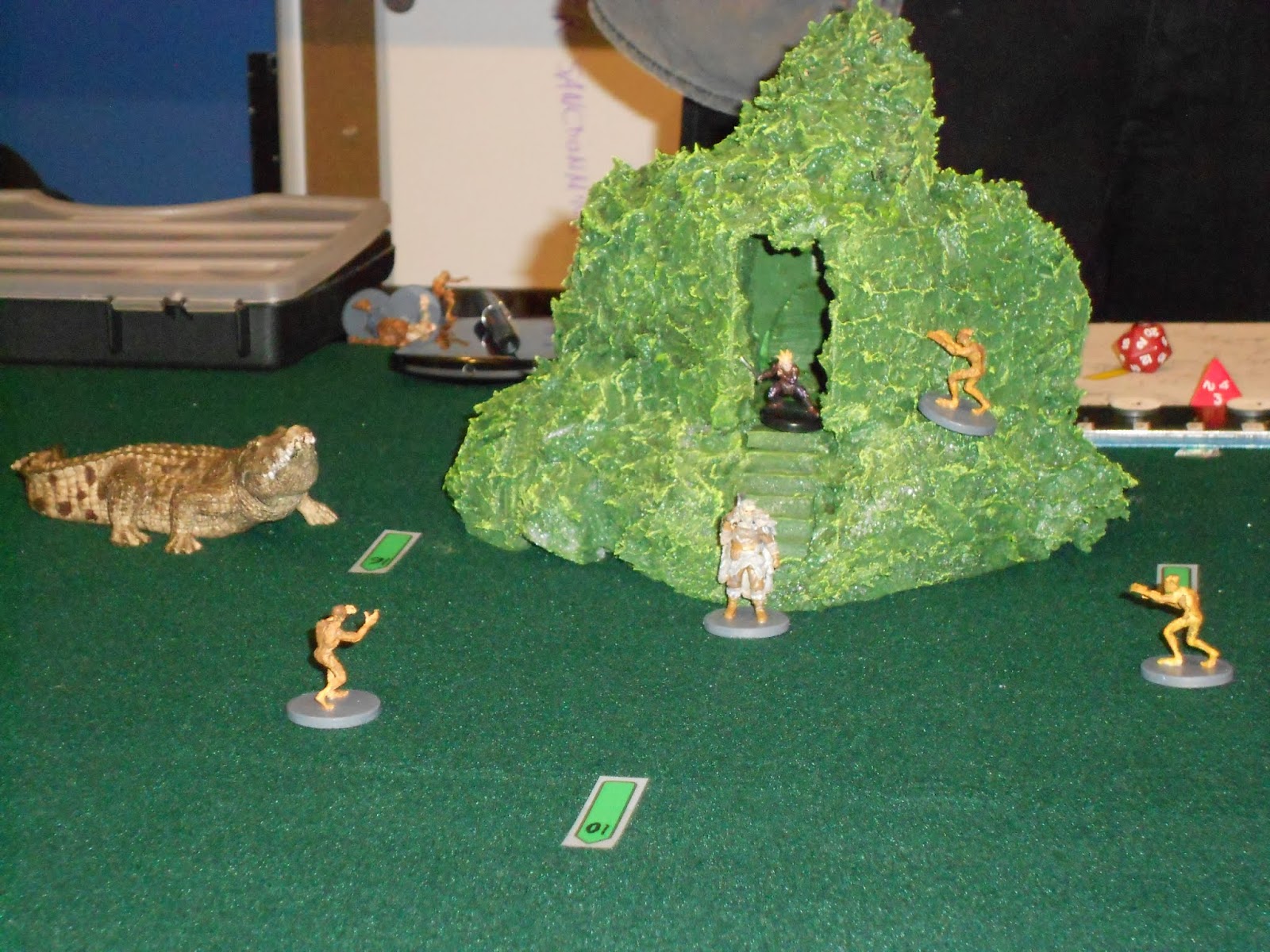

   As I said in some previous posts, I am always looking for ways to break up that solid cluster of characters on the battle mat. The emerging structure / emptying ballast device is certainly one of the most interesting ways I have managed to do so. There was also a giant gator nearby, just because it’s cool to have a giant gator in a swamp! That enormous beast ambled around and stressed the party, but in the end it did not attack. It was quite confused after that colossal stone structure just rose from the tranquil depths of the swamp. There was a scenario option in which one character could have been dragged underwater by the gator and then released as the structure sank back down a minute later – and that one character could’ve actually entered the dungeon through a submerged back door. But I didn’t use that option.

   Heir blasted one ghast with 3 magic missiles and then jumped 50 feet in order to rescue the paralyzed Brother Tom. Landa succeeded in turning all three ghouls on round two. The thief swam towards the entrance, while the barbarian quickly clambered on top of the slimy structure. Once he was up there, Huthak shot the two closest ghasts with several arrows. Heir carried Brother Tom all the way to the entrance, with some help from Landa at the end. Landa cured Brother Tom’s paralysis with a bead of curing taken from Tom’s Necklace of Prayer Beads.


   They entered the “tower” just as it slowly begun to sink down again, and went down six flights of stairs to a rather large room with round corners containing a rich assortment of undead creatures – one sleeping revenant, one wight, one ghoul, one ghast, two skeletons, and two teenage zombies (25mm zombies in a pack of 28mm undead: let’s be creative here). There were also two shadows, but the party failed to detect them at first. The room was so cluttered with furniture, crates, a small raft, debris and rotting clothes. Three crystal balls were sitting on a large console in the center of the room. The larger crystal ball was actually mage Anupar’s spelljammer helm. The two lesser crystal balls displayed scenes from the outside, exactly like the screens in a Tekumel tubeway car.

   Each of the two clerics could only attempt to turn one specific undead type per round. Landa first turned the wight, and Brother Tom failed to turn the two skeletons. All these undead were harder to turn because of the evil Goblin cleric hidden nearby, who channelled dark power through his Amulet of Controlling Undead.

   The two shadows surprised the party, and there was melee. The barbarian clashed with the 28mm shadow, and Brother Tom battled the 25mm shadow – yep, that is how I distinguished between the two.


   Heir cast his first fireball at the revenant, also engulfing the ghoul, one zombie, and one skeleton. This is when my cool homemade necrophidius appeared through a gaping hole in the floor and performed its Hypnotic Dance. Heir, Huthak, and unlucky Brother Tom all failed to save vs Spell. Six seconds later the necrophidius retreated inside its hole. A hulking flesh golem climbed up the stairs, and made to join the fight. Landa was now battling an armored skeleton and a shadow, while Grimbald the thief tried everything he could to snap the two level 6 characters – Brother Tom and Heir – out of their hypnotic trance… As I said earlier: catastrophe!


   Slapped hard in the face by Grimbald, Heir snapped out of it, and proceeded to cast his second fireball at the revenant (again) and the two zombies. He rolled an impressive 28 points of damage on 6d6. That’s definitely a hell of a good fireball. All three targeted undead failed to save and were deep-fry carbonized.

   The brazen Hobbit wasn’t there that day, and of course nobody else dared crawl inside that hole in the floor which was full of surprises – including a talkative penanggalan – and could eventually get someone right behind the witch / boss, without her knowing. Oh, and there was also a slight chance of drowning...

   As a DM, you want at least one character like the Hobbit bard in your lineup of players. Every scene, he looks at what’s at hand and seems to think, “Now what can I do to make things even crazier?”

   Still, and even without a whistling hillbilly Hobbit crawling down a necrophidius-haunted rabbit hole, the entire game was far from being as dull and static as some of the games we’ve had in the past five years. The focus of the action actually shifted from the upper room to the staircase, and then from the staircase to the lower room. I call that success.


   It was crazy enough for my taste. Huthak the barbarian boldly jumped down a whole flight of stairs and found himself literally face-to-face with the Goblin cleric. Heir was all out of spells except for mirror image, and instead he decided to drink a Potion of Polymorph; he transformed into a cave bear, and barrelled down the stairs to close with Jezi the witch and her dreaded necrophidius. The four other PCs had to pass through a stinking cloud: all but Grimbald failed their Saving Throws, and lost one round. Landa was struck with a lightning bolt. Huthak was hit with cause serious wounds. “Bear Heir” was slammed with several minute meteors, and everyone was affected by the Goblin’s sneaky disrupt life. Landa cast guidance on Bear Heir, and then cast entangle on a lone wraith. Grimbald vaporized that wraith with his Mind Flayer ray gun. That was cool.


   Huthak and Grimbald fought the Goblin while two clerics and a bear took care of the witch and her necrophidius. Jezi Béthorm died, but her Goblin husband fled the scene with a well-timed plane shift, vowing to return and avenge his dear old wife’s death.


   My biggest fear was to see the party remain in the upper room and “wait it out” until the end. Very static indeed. I put a lot of work into that Y-shaped staircase – but in the end, yes, they did go down those stairs, and even used both sides of the “Y” fork. I was a very happy DM. I recently wrote a blog post about this – getting it just right. This time, we did!

   Brother Tom and his friends now have a magical lair that travels underwater all around Ambog Swamp, but that’s not all: if they ever learn to steer the thing, they could follow the bayous all the way down to Blackmoor and the sea – and then go just about anywhere they choose.

   It is the biggest magic item that I have ever given out in any role-playing game. I’m very happy for them. Well done, guys!


5/15/19

Rules Light


   I read this on Twitter. Someone said, “Fuck narrativist and rules light.”

   At first I thought it was just plain stupid. Then, I thought about it some more. Why in the world would anyone prefer to have more rules? “Rules heavy” feel like snail mail. I am forty-seven years old, and I don’t want to sound overly dramatic here, but I have probably lived way more than 50% of my life; I’m sorry, but I neither have the time nor the energy to flick through the pages of four books to look up charts and tables and modifiers and argue about special nighttime mounted engagement rule number 284-G. But – apparently – lots of people my age still avoid rules light. Why is that? Masochism?

   Most men are what you might call hardware buffs: we love our building blocks, and it is how we interact with the world around us. Whenever my dad or my uncles are anxious or stressed, they build (or repair) something.

   In the microcosm that is gaming, “building blocks” translate into rules, while the rest translates into lore. Crunch or fluff, aye. But the word fluff in itself is slightly pejorative.

   “Fuck narrativist and rules light.”

   Seriously?

   Role-playing games began as rules light, and narration had a prevalent place in it. Alas, to quote Mike Mornard’s review of Dave Arneson’s True Genius, “mechanics have won” over the years. Modern gamers love their mechanics. Look at Gloomhaven’s tremendous success. And yes, I enjoy playing it, but Gloomhaven is 99% crunch. And let’s not forget that good, steady mechanics enable organized play: you couldn’t have the Adventurers League with just a 56-page booklet. It would quickly devolve into the Arguing League.

   The late ‘80s saw the advent of rules-heavy games. The new trend was realism. Think HârnMaster here. HârnMaster was remarkably painful, in my humble opinion. I seem to remember writing down the words “grievous cut” several dozen times on my 5 or 6 or 7 consecutive character record sheets. That’s the memory I have associated with Hârn. I kid you not. The flow of that game was impeded every two minutes by the GM looking up some chart or matrix or table of armor or listing of critical wounds or diseases or fumbles... I have dermatitis and gingivitis and migraines and joint pain in real life; I really DON’T need infections or muscle tears when I try to escape into a fantasy world! Gimme a break, Doc, will ya?

   If this were The Voice or something like American Ninja Warrior, the crunch would be the performances, scores and / or judges input, while the fluff would be those short bios shown right before every contestant’s performance.

   I love Ichabod Ferndweller, and I love Viari. I don’t know what level they are, or how many hit points they have – and I don’t really care. I do not love Eldar Phantom Titan number two, even though Eldar Phantom Titan number two single-handedly destroyed over fifty units of Dark Vengeance Chaos Cultists. Who cares? You like someone for their “fluff,” not for their crunch. Capt’n Crunch is the only exception I can think of.

   I checked out one streamed game of Gloomhaven and didn’t even watch for an hour. It is super boring. Who wants to see four guys manage their 10 cards and select the lowest possible initiative count so that the Tinkerer is given ample time to heal the Cragheart before the Archers attack. Picture that for a solid three hours. Pure crunch is un-streamable because it is almost unwatchable.

   I no longer bring the books with me on Game Day. I prep the game using the books (at home), and then the books remain at home. I only need my cue cards – but I can tell you an entire story with just your roll of a d20.

   You needed 15 to hit, but rolled a 14? It doesn’t mean you slashed wide and completely missed. Your blade might have ricocheted off the rim of your opponent’s buckler and then violently scraped against the left side of his or her helm, throwing up dazzling sparks, but not causing him or her any real bodily damage – but it was very close indeed.

   Narrativist is easy; you just need to be a little flexible and a little forthcoming. You can do it.

   Long live narrativist and rules light.


3/26/19

A First-Level Game


   This was a nice first game of 2019 and a smooth introduction for three new players in the group – which brings the grand total to a whooping 10 players. Of course I won’t be able to ever run a game with all ten characters, but the lineup will change constantly, and it is also a solid fix to the problem of those who
   a) cancel at the very last minute
   b) forget there was a game
   c) arrive three hours late

   It was a nice first game of the year for several reasons: there was no alcohol involved, no weed, very little food, and a limited amount of useless talking on subjects not at all related to the game. What I call The Four Pillars of Not Playing were almost completely absent. It was awesome. We even finished the adventure ahead of time, which has never happened since I kicked off this campaign of First Edition AD&D back in July of 2014.


   Four strangers who don’t know each other suddenly find themselves stranded in a drifting Water Node inhabited by grey oozes, giant caterpillars, and maybe a few Tritons or Deep Ones. Landa, the third-level cleric of Istus, has already played several games. The three other “strangers” are a Gnome thief, a Human druid, and a Human monk. The monk is actually one of the pregen characters from last summer’s Caves of Chaos extravaganza. Vincent loved this character and decided to keep it.

   In the Water Node, the party came across Huthak the barbarian, who had been lost for weeks in a network of underground caves and lakes. They also encountered a mule, an 8-year-old boy, and a 10-year-old girl (NPCs). Nobody knew how or why they ended up in this place.

   The players were sharp, focused, and everyone role-played their character to a tee. They cared for the children and even the mule, and moved around freely in this strange dungeon. The party was never huddled in a tight knot like I have seen so many times. It was fluid (Water Node pun unintended) and quite refreshing.


   The monk and the barbarian fought a pair of giant caterpillars. The cleric was targeted by an obliviax and had no choice but to eat that disgusting moss. The thief and the druid had to deal with two grey oozes.

   The thief also inspected the bizarre doors that stood right in the middle of the room, apparently leading to nowhere. No traps were detected, but as soon as he poked his head inside one of the doors, the thief vanished, and a tall, imposing knight in full plate armor appeared, wielding a huge two-handed sword. Greyhawk buffs will recognize this fell crest.


   Let’s just say that the party had a brief encounter with the elusive leader of... that. It was fun and spooky. A double banishment was cast upon the cleric and the monk – the second- and third-level characters in the group. Landa nailed her Save, but Dalmas the monk ended up in Hell for maybe 30 seconds. A very cool devil with a punk-rock attitude took pity on him and quickly sent him back – even forgetting to fill up the appropriate paperwork!

Standard

non - incident

statement


short form

6757049

I hereby declare and assert that nothing of significance

happened between I, ________________, and the Office of the

Monarch of the Dominion of Hell, any of its branches,

subsidiaries or affiliates.


               Initials _______             Clerk’s Initials _______


   The knight approached the barbarian and struck him down with one swing of his two-handed sword. The cleric stepped in and was also slashed by the knight, but did not go down. Even the 8-year-old NPC threw a rock at the knight and hit with a surprising roll of 19! On round four, the cleric brought the barbarian back up to 3 HP. The party needed its tank, badly.

   The druid sneaked behind the knight with a torch, setting his black cape on fire. The knight pivoted, took a swing at the druid, and dealt 8 points of damage, which left the druid with 2 HP.

   By then, the barbarian was back up, and he rolled an excellent To Hit with Landa’s guidance. The knight collapsed in a rustle of armor and shield. It was a short but eventful clash. The monk was shook after his 30 seconds in Hell.

   Nobody dared to touch the two-handed sword or the shield.

   The monk searched the knight thoroughly (apart from sword and shield) and found two gems, a few silver pieces, and a cursed coin in the knight’s right boot. The coin probably contributed to the evil knight’s demise – and now Dalmas is stuck with that double damage curse... If the hidden coin had been a good magic item, the players would have been furious if they missed it. “You searched the guy, but you didn’t tell me you took off his gloves and boots.”


   When Landa entered the “doors to nowhere” along with the two kids, the thief reappeared with a strange magic item in his hands. Each in turn ventured into that pocket dimension. Some saw the exit, while the others saw a mystical cache of floating magic items. They ended up grabbing three of those items before everyone could finally “see” the exit (WIS check) and get out. The thief picked up a Mind Flayer Ray Gun; the cleric picked up a flower-shaped morningstar +4; the monk got himself a Diabolical Flying Carpet (how appropriate!)

   The druid’s high WIS prevented him to see the items as he saw the exit on the very first try. As for the barbarian, he is not allowed to use magic items – not until level 5.

   First Edition, baby.

   Landa is now level 4. Dalmas is now level 3. Barbarian, druid and thief are level 2. The stage is set for the next adventures. Ten players. My feeling is that 2019 is gonna be intense.


1/22/19

Getting It Right


   Last August at the end of my big birthday game, Landa, the Elf cleric of Istus, and Ockná, the Hobbit bard, were cut off from the rest of the party and stuck in a nexus chamber. They had to choose between five teleport exits: Irongate, Rel Astra, Fellreev Forest, the Valley of the Mage, and the Elemental Plane of Air. They didn’t know it was Irongate or Rel Astra, but they saw a picture of every possible destination, and a big, crowded city looks way less risky than the Elemental Plane of Air. Each destination had its own specific challenges and dangers, but the Elemental Plane of Air was definitely the most challenging / dangerous of the five.

   In a city like Rel Astra or Irongate, they could have located a College of bards and a temple of Istus, along with rangers and guides to escort them back to their home turf around Phostwood. But no.

   They gleefully hurled themselves into the Elemental Plane of Air.

*

   Brother Thomas, the cleric of Boccob, and the two magic-users, Klynch and Heir, were trapped in another section of the dungeon, and they also faced a dilemma. They had to choose between four destinations / encounters: negotiating with two gauths, walking into the unpredictable Shadow Door, passing through a rift hole, or heading right into the Sanctum and clash with 27 cultists. Again, each option had its own specific challenges and threats – but the frontal assault on 27 cultists was by far the riskier path.

   They charged the 27 cultists.

   Yep.

   One cleric, level 5, two magic-users, levels 4 and 6, and one fighter NPC, level 3, against 27 cultists, levels 1 to 3. There’s no denying it: it was a ballsy move.

   But wait. Hold your horses.

   Every year I work my ass off to build interesting, demanding, hellacious terrain like this abandoned witch tower, or that room with stairs and platforms and various nooks and crannies to climb or hide or fight into…


   Players never do what you expect them to do. I get it. Role-Playing Games 101. But how come they’re always super careful and super hesitant to dive into the madness when there is beautiful terrain on the table, and so damn bold and fearless when all I have is a paper map and pieces of blue foam for cultists? What gives?


   This Sanctum with the 27 cultists had 198 HP worth of baddies to dispose of, and would deal between 68 and 170 points of damage due to 34 magic missiles.

   In comparison, the abandoned witch tower only had 45 HP worth of orcs inside of it, and that cool dungeon room with the undead dragon had 165 HP.

   Seven players didn’t even approach the witch tower – we just made lots of smoke effects around it with the ranger’s e-cigarette. And all seven players remained huddled together in the center of the elaborate dungeon room – where there was nothing – for the entire scene! They were a party of seven, with three fighters, and the entire room had 165 HP; two years later, a group of four, with but one fighter, charges 27 cultists with 198 HP.

   Go figure.

   My next big game with lots of terrain, I’m gonna tell the guys, “If you want to go crazy and charge the enemy, now is the time to do it! You jump into the god damned Elemental Plane of Air when I don’t have anything prepared, and you charge 27 cultists when all I got is an ugly white map and 20 pieces of foam – and I’m all for it. Fearless is the way to go in D&D. Just don’t forget to be fearless and ballsy when I put 100 hours of hard work on the table for your sole enjoyment.”

   Go ahead. Charge. Scatter around. Climb that wall. Tumble down those stairs. Look into that dark hole. Pull that lever. Touch that strange crystal ball. Think of it as if it were a bunch of cultists. You can do it.

   We can’t say it enough: getting it just right is hard. The magic formula for a perfectly balanced game simply doesn’t exist. Role-playing follows a changing, chaotic recipe with fickle, temperamental ingredients.

   Now, I still have to run a solo game for the barbarian, because he was cut off from Landa / Ockná and from Heir / Klynch / Brother Tom. If I offer him the choice between a wrestling match with Demogorgon in a lava pit and bargaining with two hobgoblins, he’s gonna wrestle Demogorgon, right?


12/23/18

Corporate Role-Playing Games


   This is called “Go,” and it is a Chinese game. There are no extensions, no patches, no DLC and no booster packs. It’s just the board – a 19×19 grid – and those black and white stones. That’s it.

   And it’s great.


   This game has endured for twenty-five hundred years without a Second or Third or Fourth or Fifth Edition, and without Twitch.

   What am I getting at, you ask?

   When I was thirteen years old, my dad put me up in a private school, and the other kids there had expensive pastimes like alpine skiing or tennis or bike racing with 10 speed Carbolite Peugeot bikes. Luckily, there was also a D&D club. I chose role-playing games because it wasn’t as expensive a hobby. Three core books – yay!

   Lots of things have changed since.

   There was this little debate on Twitter about a year ago: Was it possible to play D&D for free? At first, I thought it was a joke. Of course you can play D&D for free – or any other role-playing game, for that matter.

   Spend Money Regularly to Stay Engaged in Your Hobby is a blatant marketing model, and it is contrary to almost everything Gygax and Arneson envisioned in the very beginning. Granted, these guys were no businessmen – not in the corporate sense, that is. We must remember how Gygax, in the beginning, was opposed to the idea of published adventures. In his own vision of D&D, you were supposed to stay engaged with the hobby through your very own creative process and imagination. The merchandise line itself was named Products of Your Imagination.

   Imagine that.

   I’m still running First Edition AD&D. To be frank, I feel both satisfied and guilty at the same time. Satisfied, because those consecutive editions are nothing but an attempt at making more money. Guilty, because I clearly don’t do anything to “help my hobby,” as they say.

   Then again, where does that notion of helping your hobby even comes from? Is my dad helping chess in any way? He still plays with his old chessboard and pieces from the sixties – and he only ever plays with his friends and a few neighbors. My dad really isn’t helping the hobby of chess.

   I don’t think the hobby of chess needs any help from anyone.

   Now, there is a major difference between role-playing games and Dungeons & Dragons. Role-playing games are like chess – they don’t belong to anyone, and don’t need any help. Dungeons & Dragons, on the other hand, belongs to Hasbro, and Hasbro’s purpose is to make money. Thus, D&D needs help. It’s weird, I know.

   Imagine how weird it’d be if chess belonged to Hasbro and suddenly needed “help.”

   People buy stuff. It’s what they do. It’s their voice. When they’re happy, they buy. When they’re unhappy, they buy something else. If they agree, they buy, and they buy differently if they happen to disagree. That hasn’t changed. People keep buying.

   What’s actually changed is: small ain’t beautiful no more.

   Or rather, because of the Internet, small can sometimes get blown to stratospheric heights, like Matt Colville’s Strongholds and Followers. a simple homebrew idea put up on Kickstarter that suddenly collects over two million dollars. In this case, small is so beautiful it becomes HUGE.

   But then, “small” business people feel threatened by smaller bloggers or non-profits. That, also, is contrary to Gygax and Arneson’s original vision. Someone told Jeff Berry that his amazing blog was “a detriment to their business interests.” Man, oh man.

   There are way too many business interests in this world and definitely not enough genuine people like my friend Jeff / Chirine ba Kal.

   If you remove the Internet from this equation, it’s 1980 all over again: every Dungeon Master developing his or her own campaign, some DMs sending their work over to Dragon Magazine and crossing their fingers – and once in a blue moon, a lucky one like Lawrence Schick (White Plume Mountain) seeing his creation published.

   Nowadays, anybody can be Lawrence Schick, write his or her own White Plume Mountain, and sell it. Unless you put your stuff online for free, that is – and then you become a detriment to somebody else’s business interests…

   And is there really more variety now?

   Maybe, maybe not.

   When White Plume Mountain came out in ‘79, everybody played that adventure simultaneously. Same thing with Expedition to the Barrier Peaks, one year later. At one point, every AD&D character I came across in the club owned a blaster rifle, wore a suit of powered armor, or wielded the sword Blackrazor. Party #1 and party #2 and party #3 met at the Green Dragon Inn, and it ended in a Star Wars gunfight. Everyone had had the chance to explore a spaceship; an entire friggin’ fleet had crashed in Western Flanaess.

   Most of us still play the same adventure at the same time in 2018. Think Tomb of Annihilation.

   Sly Flourish said to Chris Perkins that he shouldn’t spoil the ending of Tomb of Annihilation in his streamed game. To which Perkins politely replied, “But you can always change the ending!”

   Well, yes. And now we’re back to square one, aren’t we? Or rather, we’ve come full circle. It’s your homebrew game. Like in 1980.

   Corporate is the new norm. Anything that was original and one-of-a-kind becomes corporate sooner or later. For instance, Person of Interest told the story of one man and his offstage efforts to change the world all by himself, or at least make it a better place – with no government oversight, no sponsors, and no investors. Wisdom of the Crowd was a corporate rehash of Person of Interest.

   Same thing happened with The Mentalist. This guy was gifted, knowledgeable, very charismatic, and always did his own thing on his own terms. Bull is nothing but a corporate retelling of The Mentalist.

   Everything geeky has now become something corporate and (most of the time) entirely unrelated. Google searches are fascinating.

  • “Greyhawk” is a consulting firm
  • “Palantir” is a technology company
  • “Orthanc” is a medical imaging server

   Take the next fresh new thing, and turn it into a corporate thing.

   Role-playing games aren’t any different. D&D once was an edgy, fresh new thing. Arneson and Gygax didn’t intend for this hobby to perpetually need its player’s influx of cash.

   Irreconcilable conundrum?

   It’s a blessing, in fact. Cheaper than Peugeot bikes, remember? Anyone can role-play. And I really do mean anyone. Pick up a few dice or one of those dice rolling apps, choose a system – Tri-Stat, Black Hack, whatever – and start a game. The wine remains the same, even though they keep pouring it into a different container every ten years or so. Companies are containers. Big corporations are bound to be nothing more than scattered footnotes in the checkered history of tabletop role-playing games.


12/2/18

The Truth About Maps


   Maps are a universal staple of tabletop role-playing games. Everybody loves maps. But I recently came to the realization that maps are, in fact, almost useless. And here’s why.

   For four years now, I have been running a First Edition Advanced Dungeons & Dragons campaign set in Greyhawk, 150 years before the Nyrond / Great Kingdom split. After fourteen game sessions and 9 different adventures, the player characters still don’t own a map of their region – and they don’t seem to need one. The ranger knows how to get from point A to point B most of the time, and even my own “DM’s map” is nothing more than a sketch made in 2015, onto which I keep adding details and numbers as the campaign progresses.

   One cannot even compare my lousy DM sketch to the gorgeous map of the Sword Coast people use when they run 5E. But honestly though, I don’t think I need much more than this little sketch. If the PCs ever leave the area and head for Rauxes, Irongate, or Greyhawk, I’ll just make another sketch, and continue the story.


   In The Lord of the Rings, the heroes don’t have maps – they have guides, which is much more reliable. Gandalf knows a shortcut to get from Rivendell to Lothlórien. Aragorn knows the way from Lothlórien to Edoras. Gollum knows how to get into Mordor without going through the Black Gate...

   “Hold your horses,” I can hear someone say. “Tabletop role-playing games stems from Tolkien and Robert E. Howard – and these books had maps!”

   Sure, I say. There’s no denying it: we are a visual generation. The Lord of the Rings have beautiful maps, but they’re meant for the reader. Aragorn himself don’t have these maps, and never will. What kind of mapping do people in a medieval world really have access to? Think about it. Drawing accurate maps is a hard thing. Even good old Italy is a misshapen blob on most medieval maps – and Italy is a rather straightforward peninsula! If they couldn’t even get Italy right, what about the rest?

   Even Florida (and that is after the end of the Middle Ages) is fucked up on some sixteenth-century maps. Florida is even simpler than Italy, and they still couldn’t get it right until 1820!


   If I ever provide my players with a map of Rel Mord and its surroundings, it’ll be full of hilarious mistakes and wildly inaccurate, believe me.

   And what about those beloved dungeon maps? As Dungeon Masters, do we really need such maps or could we possibly do without them? The Caves of Chaos, that is okay. The Tomb of Horrors, alright. But what about sprawling megadungeons like the Tekumel Underworld or the Underdark – who needs a complete and accurate map of that?

   In my First Edition AD&D game, I no longer map my dungeons. I build interesting rooms and passages – bottleneck locations where fighting is bound to occur, and that’s it. The only other thing I need is an intuitive chart of what that labyrinthine complex might look like. A “dungeon flowchart,” if you will.

   The Three-Tiered Room is a complete diorama, and so is the Obelisk Chamber. The Duergar Throne Room and the Shrine of No Spells both use the same basic terrain, only with different bits and accessories. The Duergar Maze and the Deep Lakes don’t have fixed, pre-assigned terrain. And all remaining areas can be described orally. I don’t need a map.

   “You went through eleven different rooms, nine of them smallish and all of them empty except for excessively thick dust and a few pieces of decayed furniture. No secret doors and no scattered bones anywhere.”

   “Can you map these rooms for us?”

   “You go right ahead and do it yourselves. The nine small rooms are more or less clustered around the two larger rooms, separated by various short passages.”

   Players 1 and 2 come up with two very different maps. Roll INT checks. “Maybe the cleric was a little muddled. There is a slight stench in the air; spores, maybe, or weird unseen fungi... Anyway, the thief appears to be right. His map is fairly accurate. Now, what do you want to do?”

   If the players should ever decide to lure the Duergars away from their Throne Room and ambush them in some corridor where they can take them two at a time, no problem. I can whip up any stretch of corridor with modular dungeon walls. “You made enough noise banging shields together for five minutes – the Duergars are coming. You already see five or six of them. Do you prefer a straight corridor, a T-shape, or one with a 90-degree angle?” The Duergar Maze sector certainly has at least one straight corridor, one T-shaped passage, and many 90-degree angles. I’ll build whatever I need. What I don’t need is a complete blueprint of that rather large maze.

   Again, maps are a universal staple of tabletop role-playing games, and that ain’t going to change anytime soon. Everybody loves maps – and that includes Yours Truly. Because a beautiful fantasy map is like a beautifully painted Tiamat or Orcus figure: it’s pretty nice to have, but you can run memorable games and campaigns without it.