11/4/19

Descent into Malbolge


   In May of 2017, Heir Malezia, a level 4 magic-user, signed an infernal pact that granted him two additional levels of experience; that character suddenly went from a puny caster of magic missiles to a multiple-fireball-throwing badass.

   In August of 2017, the entire party went to Hell, on a very specific mission. For those of you who have been readers of this blog for a while, you’ll probably remember that particular post. When the party reached Avernus, each character appeared on a large rune belonging to one of the nine Planes of Hell. Each player drew a card, and each of the cards had a short text printed on it. “If you ever return to Avernus after today, you will become a Lemur, and serve Tiamat for all eternity...” “If you ever set foot in Dis, the Second Plane of the Nine Hells, you will be transformed into a pillar of salt...” Et cetera. Each character has one specific Plane of Hell where they could never, ever return or go.

   Fast-forward to October of 2019. The level 6 Heir Malezia is visited by a contract devil who basically tells him, “Dear Sir, your time is almost up – but you can sign this contract right here, and resell your Mortal Soul to my master, Duke Hutijin. Alas, any new contract will only take effect if you break into the Infernal Vault and destroy the original contract you have signed over two Years of Man ago. A teleport circle is included herein, and you can bring up to eight comrades along with you on that heist. You won’t be able to remain inside the Infernal Vault for long, though. Every intruder will be teleported out after a brief moment. Make each second count.”

   Easy enough, right?

   But wait – the Infernal Vault is actually a meteorite that constantly moves through six of the Nine Hells, between Avernus and Malbolge. Which layer is the Vault currently into? Which character is going to become a Lemur – or a pillar of salt – because he was forever banned from that particular Plane of Hell?

   Is it worth risking the ranger’s life, or the bard’s life, or Brother Tom’s life, to save an evil-adjacent magic-user? That’s for the group to decide. I expected a huge debate, but in fact it proved to be rather quick and straightforward. When one member of the party faces Imminent Death, the others usually step up. And so they did.

   Landa the cleric, Huthak the barbarian and Dalmas the monk did not take part in that 2017 expedition to Avernus, so their lives are not at risk. They could still perish, mind you, but not of a sudden death right at the beginning of the game. As for Heir Malezia himself, his 2017 rune had been the Nessus rune, so he can never set foot in the ninth Plane of Hell. Anyhow, the Infernal Vault does not travel that far.

   They drew one of six cards – and that card told us that the Infernal Vault was currently passing through the Sixth Plane of Hell. A big sigh of relief. The bard cannot go to the Second; the ranger can’t ever set foot in the Fourth; and Brother Tom can’t go to the Fifth. In Malbolge, the PCs were all safe. Sudden death averted!


   Each of the six PCs and three NPCs appeared on a different bluish star carved in the Vault’s floor. They immediately observed that seven out of nine vaults had guardians: 3 Death Knights, and 4 four-armed gargoyles.


   Brother Tom and NPC Klovis charged one of the Death Knights. The ranger and Landa attacked one of the gargoyles. Dalmas the monk deployed his Diabolical Flying Carpet.

   Nobody ever got within 5 squares of the vault on the far left or the one on the far right, even though the one on the right didn’t have any gargoyle or Death Knight standing in front of it.

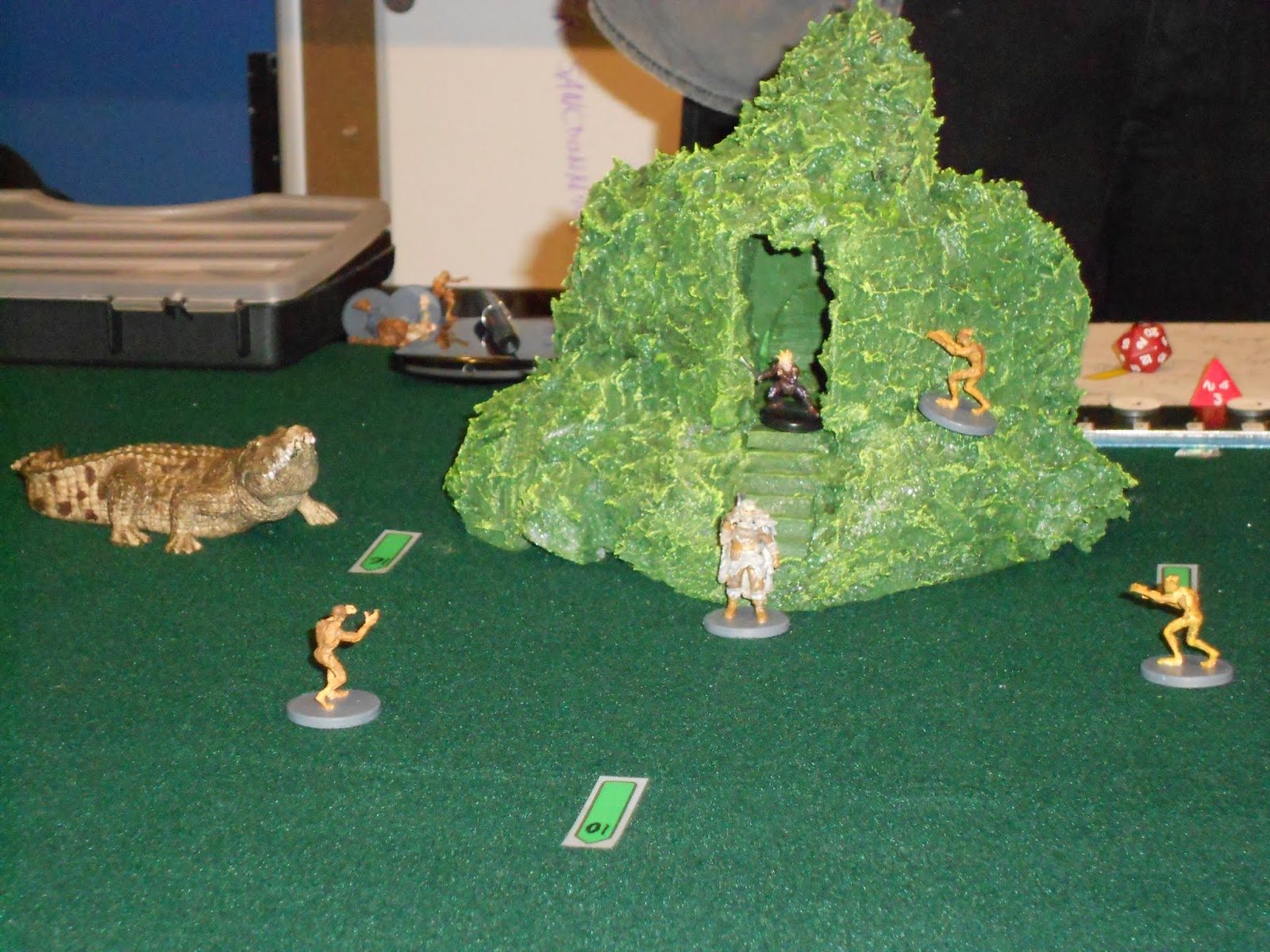
   A Rage Drake emerged from the ominous cave-mouth underneath the tower.


   The second Death Knight created a wall of ice right in front of his vault, and then left his post to go after Heir and Klynch, the magic-users. The party wouldn’t be able to get to that frozen vault for the rest of the scene, of course.


   One stellar moment occurred when Klynch, the level 5 magic-user (the one who didn’t sell his soul), decided to take on the Death Knight who had left his post. Just to give you some perspective here: Klynch has 14 Hit Points, wears a pair of cursed Bracers of Defenselessness, and has a +3 dagger of Petrification with only 3 charges left in it, while the Death Knight has 75 Hit Points, a 50% magic resistance, and wields a two-handed maul +1.

   First, Klynch casts spider climb to haul his ass up on the lower ledge of the tower. The following round, he casts monster summoning, and a dire wolf appears right next to the advancing Death Knight. On the third round, Klynch performs a Kirk’s Flying Tackle” from above, and jumps back down on the fully armored Knight, attempting to stab him with his +3 dagger. I allow him another +2 To Hit bonus for the jump. Still, he misses, and takes 5 points of damage from that 25-foot fall. Everyone hears a loud crunch. Klynch lies on the ground as if unconscious or dead; he’s right beside the Death Knight’s left leg, but the Knight is busy fighting the dire wolf. On round four, Klynch attempts to stab the Knight in the foot – and misses yet again. The Knight pays no attention to him, and tries to finish off that pesky wolf.

   Round five: Klynch attempts to stab his opponent in the nuts, since he’s lying on the ground, and quite perfectly positioned to do so. He needs 16. With the +3 dagger, he needs 13. He rolls a solid 15. This time, it’s a hit! I roll 2d10 for the Death Knight’s magic resistance, and get 80. The Knight doesn’t resist to the magic. Then I make a Saving Throw vs Petrification, and roll a 2.

   The Death Knight is turned to stone!

   Epic and hilarious.

   Remember, kids: killing huge monsters is possible, even if you only have 14 Hit Points!


   Elsewhere in the Infernal Vault, Landa, the bard and the ranger whacked two of those 4-armed gargoyles, and quickly emptied two vaults full of infernal contracts. Rot grub rained down on the ranger and the bard as they poured acid onto the contracts to destroy as many of them as possible.


   Dalmas the monk brought his flying carpet around: Landa, the bard and the ranger hitched a ride on it. Down by the pool of lava, the first Death Knight cast power word: kill on Brother Tom. Save or die!

   Brother Tom made a successful Saving Throw. There was another big sigh of relief.

   Meanwhile, Ashtag the Drider, an allied NPC, fought against the Rage Drake. Heir cast one of his jump spells to close in on one of the remaining gargoyles. He then cast fireball, and rolled 30 points of damage – his best damage ever on 6d6, beating a previous record of 28.


   A pair of shrieking harpies then showed up. The Rage Drake disengaged, skirted the base of the tower, and leapt 20 feet onto the flying carpet. Ashtag took it upon himself to tackle both harpies. Dalmas had no other choice but to fight hand-to-hand with the Rage Drake. Monks – what can I say?


   In the end, the party had enough time to empty 5 out of 9 vaults, destroying 1742 infernal contracts. Then, everyone was teleported out. It’s a safety feature of the Infernal Vault. But the devils really need to improve their security, right? Eighty-one Dukes and Duchesses of Hell just lost 1742 souls – their most precious holdings and valuables.

   Duke Hutijin, the one who bought back” Heir Malezia’s soul by facilitating the party’s access to the Infernal Vault, couldn’t care less for the mighty mess he’s created. Hutijin serves Mephistopheles, and Mephistopheles is Asmodeus’ main rival. The Infernal Vault contains infernal contracts belonging to Duchesses and Dukes aligned with Asmodeus. Vassals of Baalzebul and Mephistopheles keep their paperwork on their own Planes of Hell: the Seventh and the Eight. They didn’t lose a single soul during that most brazen heist.

   Yes: the party has unwittingly entered the tortuous field of Hell’s politics. Powerful devils will certainly seek swift revenge!

   Even the final reveal was great. I put 9 cards on the table, face down – one for each of the 9 vaults. Heir had to pick 5 cards, since he and his comrades had managed to open 5 vaults and destroy all infernal contracts stored inside.


   Of the 5 cards that had been drawn, the Heir’s Contract! card turned up fourth. We had awesome suspense up until the very end. The other players yelled, “Nope… Nope… Nope!…” and then, when the right card was flipped, there was a loud cheer around the table. What a perfect ending to a D&D game session. Imagine if “Heir’s Contract!” had turned up first; talk about jumping the gun!

   A time constraint, killer odds, and epic Saves to make.

   After such a game, players can truly say, We played D&D!

   One friend told me, My social life ain’t much these days, and your gaming events are a welcome break from monotony!” I couldn’t have asked for a better thank you.

   Several gods smiled down on us. Arneson. Gygax. Istus. Mephistopheles…


10/15/19

A Study of Beholders


   With every year that passes, beholders are getting angrier.

   The beholder shown on the cover of 1975’s Greyhawk was just a smooth ball of baleful eyes floating around, expressionless. A wider, more distinct mouth was added in 1977’s Monster Manual, with silly grin and pointy teeth. Obviously, the wider mouth was put there to enhance facial expression. One central eye and a small piehole doesn’t allow for a very wide range. It’s a one-eyed fish kind of situation.

   With a wider mouth, you’ve got more options. The 1977 beholder seemed happy enough – and why would any beholder be unhappy? I’d certainly have a silly grin on my face 24/7 if I was lucky enough to fly and have a disintegration ray and a charm person ray!

   What I call the unifrown came along seven years later, in 1984: it was a stroke of genius by illustrator Steve Bisset.


   With both the wide mouth and the unifrown now in place, beholders could express almost any emotion they wanted – but they only became angrier and angrier. Why is that? I’ve always thought the Greyhawk beholder was eerily frightening with its blank stare and fishlike mien. And the Monster Manual beholder was creepy because of the aforementioned grin. “Look at that merry psycho sphere of evil!”

   The modern beholder, that lick-spittle ball of spikes and fury, is a little over the top for me. Why are they so angry all the time? Hey, Eye Tyrants, relax! You guys are way up there with the liches and red dragons. Chill out, will ya?


   There really isn’t much to go on in the 1983 article The Ecology of the Beholder. It reads more like a chapter in a novel about a boy who is probably going to become a paladin. The article only tells us that the beholder’s flight isn’t magical in nature, and that every beholder spits 1 to 4 eggs per year from its mouth. So, a dispel magic or an antimagic field cannot cause a beholder to drop down. Nothing would be more pathetic than a helpless beholder rolling on the floor, unable to fly. And beholder reproduction also seemed absolutely ludicrous. Imagine, if you will, those mating positions...

   All beholders spit eggs from their mouth.

   No sexual organs – maybe that’s why they’re so angry all the time.

   But let us dig a little deeper here. For instance: skull, or no skull? One could argue that the chitinous plates covering a beholder’s body are the only skeleton – or, in this case, exoskeleton – they need. But then again, they’ve got a wide maw with teeth, right? Teeth means jawbone, and jawbone means skeleton. Here is something Ed Greenwood and Roger E. Moore should have tackled.

   What would a beholder’s skull look like? It would need ten small holes for the eyestalk muscles and nerves to pass through, and it also implies that there’s an open spot down under, because if it was just solid bone all around, the articulation wouldn’t be able to open.


   A beholder’s stomach has to be located above its throat. When a beholder swallows its food, it swallows up into its stomach. (Yes, read that again.) The stomach connects to the intestines, and the intestines eventually circle all the way back to the underside of the spherical body, where the anus ought to be found.


   Older beholders would also have a sort of bulge underneath. With time, the inner organs would naturally begin to droop through the mandible aperture. An ancient beholder would look something like this:


   That’ll make ‘em angrier still.

   I guess I’m not helping much here.


Who Invented the Beholder?

   Allow me to reiterate something I have already touched upon in this blog. Beholders, in all likelihood, come from the fabled Tekumel Eyes.

   Professor M.A.R. Barker first published his Empire of the Petal Throne role-playing game in 1974, describing in it an array of 33 ancient technological devices looking like eyes, each one capable of shooting a ray of power in the direction it is pointed in. The Excellent Ruby Eye would cast the equivalent of a hold person or hold monster spell. The Splendid Eye of Krá the Mighty” would shoot a powerful telekinesis ray. The Eye of Frigid Breath” generated a pretty straightforward death ray (i.e. Save or die).

   This book was self-published one year before the Greyhawk supplement on the cover of which we can see the very first, expressionless beholder.

   What I think has happened is rather simple. Gary Gygax read about the Professor’s Eyes” and thought, “How could these different shooting rays be thrown against a D&D adventuring party, but without the constant need of non-player characters to hold and operate the devices?”

   And the answer was, of course, take a bunch of “Eyes,” make them fly, and give them a will of their own. Theron Kuntz wrote that up, since Gary himself was so busy. After that, bundling up these eyes together was just a formality!

   I’m not saying Gygax and Kuntz plagiarized the Professor. You have to put yourself back in the 1974 frame of mind: they all borrowed from each other. Tekumel’s Ahoggyá is an obvious borrowing of Ashton Smith’s Tsathoggua – and the Ahoggyá itself inspired AD&D’s Xorn. You get the gist.

   Canonically speaking, Empire of the Petal Throne is a First Edition D&D setting, so why wouldn’t the Eyes have some obscure, arcane link to the beholders, and why wouldn’t the Xorns be distant “elemental” cousins of the Ahoggyá? I’m sure there is a way to link pre-béthorm Tekumel to prehistoric Oerth via Spelljammer. You just need the lawyers to agree – and why the hell wouldn’t they? Just imagine the galaxy-spanning science-fantasy campaign!

   There must be a Beholder homeworld out there somewhere, just like there’s definitely an Illithid homeworld. Let it be said that I, for one, would buy this book in a heartbeat.


8/27/19

Role-Playing Races


   Up until recently, there were no races in tabletop role-playing games, only caricatures.

   As you worldbuild, you are faced with several fundamental choices. First and foremost among those is the choice to invent new races to populate your world, or keep the Human races we know and love, and simply reinsert them into your creation. There is an abyss of difference between Empire of the Petal Throne and Warhammer’s Old World, and making a list of every fantasy setting in that intermediate space would be a daunting, herculean task. I like to think of Robert E. Howard’s Hyborian Age, one of the very first fantasy worlds, as being centrist – more or less.

   Howard’s races were inspired by the multifarious people and empires of real History (Mesopotamia, Egypt, Greece, et cetera), while Gloomhaven came up with a bunch of original, new races. Both choices work, mind you; but if you keep the Human races, the difference between your world’s social dynamics and Real Earth dynamics is really going to matter. If your world map resembles Real Earth geography but with no Africa (like Toril) or no Israel (like the Old World), you might get in trouble sooner than later. If the people with dark skin are Emperor, First Sword of Empire, and High Mage – like in Steven Erikson’s books – your worldbuilding is obviously more positive and modern. If there are no people of color anywhere except in far-off, uncivilized parts, your model is indeed outdated. The Hyborian Age of Conan was created in the 1930s. Middle-Earth was fleshed out in the 1940s. It is now 2019.

   Gloomhaven is basically the TV show Grimm, except that everyone is Bauerschwein, Ziegevolk, Blutbaden, et cetera, and woged permanently. There are no Humans, or perhaps they only appear much later in the story. The Inox look like Chaos Beastmen from Warhammer. The Vermlings look like Men of Leng from Call of Cthulhu. The Orchids are a fuchsia version of Avatar’s Blue People. Race problem solved, right? Well, it may be an easy way out after all, but still much better than Tolkien’s swarthy Easterlings and REH’s mongrel Stygians.

   Yet, basically, they’re still caricatures. All Inox are the same; there is no Inox scientist trying to figure out why the equinoxes drift along the world’s ecliptic.


   Caricatures are easy. They’re a template. It’s like choosing a class. You’re a ranger in Dungeons & Dragons or a good old P.I. in Call of Cthulhu or a kickass bounty hunter in Star Wars. Rangers and P.I.s and sci-fi bounty hunters are all the same. The rendering is automatic, and you can see” the character almost instantly. Add a race to it, and it’s even faster. Elf ranger. Irish P.I. Trandoshan bounty hunter. Hobbit thief. There, you’re done!

   You can also create something completely new and challenging – but it requires a little more work. For the past 20 years, one of my friends have been playing a Human fighter who believes he is a Dwarf. His mother died somewhere close to a mountain pass, and the Dwarves who rescued the infant decided to raise him as one of their own. Klorghan is now a hulking, bearded, six-foot-tall warrior. Don’t tell him he’s Human, though, if you want to keep your head, that is.

   We’re also quite fond of caricatures when it comes to iconic enemies. “A necromancer lives in that old tower, and he’s got scores of Orcs under his command.” What DM never used that hook? Orcs got a raw deal very early on, aye; after decades of bad rap, they’re slowly and finally breaking out of that washed-out one-dimensional straitjacket.


   Now that we’re able to play a Lawful Good Orc paladin, or a Sun Elf assassin, is there any race left to be the iconic enemy? One answer is: choose anything not alive; golems, gargoyles, elementals, the undead... Another answer is: fight other normal people, and this one is rather interesting. Just get rid of Alignment. You’re going to square off against other people – not Evil people, but folks who want (or need) to achieve the opposite of what you want to achieve.

   Take Steven Erikson’s The Malazan Book of the Fallen, for example. In book #1, you have real, multi-faceted people (the Malazans) fighting against other real, multi-faceted people (the population of Darujhistan). Book #1 is awesome. In book #3, Darujhistan and the Malazans unite to defeat evil, disgusting cannibals. Book #3 is crap. In book #4, everyone unite (even the undead!) to defeat disgusting, evil child molesters. Book #4 is mostly crap. In book #5, normal people (the Tiste Edur) clash against other normal people (the Letherii). Book #5 is the best of the series: you read it and you literally hurt.

   If you fight a caricature, chances are, it’s gonna be crappy. If your opponents are real, multi-faceted people, it’s gonna be awesome. This recipe works. Just try it.

   Speaking of the undead – may I remind you that we all played vampires for ten years during the ‘90s? I even played a friggin’ mummy for a while! Vampires are nuanced and conflicted. Some of them couldn’t kill Humans. Some of them even acted as humanity’s guardians. So, evil or not? If a vampire can be nuanced and conflicted like that, why not a ghoul, a wight, a ghast or a wraith? Skeletons and zombies are not as evil as they are dumb. Evil requires an intent. Zombies are mindless: they have little to no intent.

   I can picture a whole party of undead. The magic-user is a lich, the thief is a Nosferatu vampire, the cleric is a ghost, and the dumb fighter is some sort of Bugbear zombie in splintered mail. Maybe their sworn enemies are a bunch of flesh and blood Humans.

   There ought to be good Orcs and evil Orcs, just as there are good Humans and wicked, evil Humans. And Hobgoblins. And Kobolds. If a race is monolithic, it is almost always a caricature. For instance, why would Elves be immune to mental illness? There are Elves with schizophrenia and psychosis, right? Why not an Elf serial killer? An Elven Hannibal Lecter? Why not a gay Dwarf scholar who never touched a battle-axe or a hammer in his entire life?

   When they needed evil Dwarves, instead of taking ordinary, Gimli-like Dwarves, and giving them wicked intentions, they came up with the Duergars. When they needed evil Elves, they did the same – and came up with the Drow. That is absurd. You can have so much more depth than that, and it really isn’t such a big endeavor. Tolkien’s original Moriquendi did not have dark skin, and weren’t any more evil than the cruel and obnoxious Noldor. The Dark Elves are the ones who never saw the light of the Trees in Valinor: it’s a metaphor.

   Back in the day, a French role-playing game called Bloodlust dealt with those stubborn caricatures in a very caricatural way – and then proceeded to replace the expunged crap with complex, nuanced races. Because that’s precisely the point, isn’t it? Nuances. Do you think all Illithids are the same? There has to be different social groups in their society: individuals with high psionic powers, and individuals with low psionic powers. It’s like our IQ. Only the high-psionic / high-IQ Illithids ever get to fly spelljammers and probability-travel around the Prime Material Plane. The others are stuck on the Illithid homeworld, toiling away. Why not play one of those? An escaped psionic slave. A Mind Flayer Spartacus.

   And what about nuances in Call of Cthulhu – why not play a good Deep One, or a tolerant and worldly Mi-Go? A Drizzt from Yuggoth, if you will.

   Mammalocentrism dictates that we favor mammals. Cats are cute, not spiders. The Mi-Go are insectoid in nature, and the Deep Ones are fish-like. Human is much closer to Goblin or Ogre than it is to Mi-Go or Serpent Man. Yet, you have played a Dragonborn, and that’s already half reptilian right there. Just keep going in that same direction, is what I’m trying to say.

   If there is a Mind Flayer Spartacus, then Mind Flayers really are a true race, and not just a caricature. If there is a Sun Elf serial killer, then Sun Elves are a race, and not a caricature. If there is a humanophile, worldly Mi-Go, then the Mi-Go are a race, and not a caricature.

   But it requires more work on the DM’s part, that’s for sure. No longer can he or she say: “You see a bunch of Orcs, and they immediately charge towards you.” If you use the nuances filter, whenever somebody – anybody really – is charging the party, they’re gonna need their own agenda, motives and motivations. Again: real, multi-faceted people against real, multi-faceted people.

   It isn’t a caricature anymore. I believe Dungeon Masters / Gamemasters / Keepers are ready to go the extra mile. I know I am.


5/31/19

The Bogged Down Swamp Game


   Brother Thomas, the cleric of Boccob, learned that he may inherit a mysterious “tower” located somewhere in the heart of Ambog Swamp. That residence belonged to his uncle, Anupar, a powerful mage with a life-long fascination for the unidentifiable ruins scattered throughout that vast swamp. But the place is now occupied by an old witch, Jezi Béthorm, and her Goblin cleric husband, Henxuk. If Brother Thomas wants to inherit, he must officially evict those squatters – with the help of his friends, naturally.

   This adventure was actually spread across three game sessions. We played the first session in December of 2017, with 3 players. It was role-play heavy, with no combat whatsoever – a rare thing. We played a second session in March of 2018, with 5 players. The level 5 ranger and the level 6 magic-user joined the party. That one was combat heavy. Orcs. Dire Wolves. Winged Lizards. Hunting Drakes. But the PCs finally got their hands on two interesting magic items: a ring, and a quarterstaff. They missed out on a tome, a weird skull, and an ever weirder talisman. Towards the end, just when they thought they’d located the mysterious tower – a Giant Troll and a Velociraptor attacked them. The ranger really made a huge difference there.


   Fast forward almost a year – because of scheduling problems, a cancelled game session, and my birthday game that couldn’t be pushed back – and at long last we got together again and played that third and last act. The party returned to Gatormouth (an Orlane-esque swamp-adjacent small town) with a new lead: a swamp lad who apparently knows exactly when and where the “wizard’s tower rises from the murky waters.

   And guess what? The lad is right.


   So the party followed the kid’s directions all the way to Moth Lake. When the enchanted lair emerged, it generated a mini tidal wave – and then, from the lone entrance of the edifice, water came pouring out – a lot of water.

   Inside that tsunami, floating undead!

   I had a little chart prepared especially for that purpose. Each PC had a different die roll to make, depending on Strength, Dexterity, and type of armor worn.

   The thief and the barbarian were the lucky ones: that mini tsunami actually carried them towards the magical lair. Heir the magic-user was pushed back to the left of the mat. Brother Tom was swept off his feet and carried over to the right side. Landa ended up in deeper water, close to the middle and slightly to the right.

   Nine ghasts and three ghouls “vomited” by the emerging structure also ended up in random spots: either neck-deep in the swamp or further away inland, up to 60 feet east or west.

   The water finally subsided, and we rolled initiative. The two clerics attempted to turn as many undead as they could. Brother Tom successfully turned six of the nine ghasts, but in doing so he was attacked by a ghoul and failed his Save vs Paralyzation. Catastrophe further developed as Landa rolled a 2, not turning any ghoul at all on the first round.


   As I said in some previous posts, I am always looking for ways to break up that solid cluster of characters on the battle mat. The emerging structure / emptying ballast device is certainly one of the most interesting ways I have managed to do so. There was also a giant gator nearby, just because it’s cool to have a giant gator in a swamp! That enormous beast ambled around and stressed the party, but in the end it did not attack. It was quite confused after that colossal stone structure just rose from the tranquil depths of the swamp. There was a scenario option in which one character could have been dragged underwater by the gator and then released as the structure sank back down a minute later – and that one character could’ve actually entered the dungeon through a submerged back door. But I didn’t use that option.

   Heir blasted one ghast with 3 magic missiles and then jumped 50 feet in order to rescue the paralyzed Brother Tom. Landa succeeded in turning all three ghouls on round two. The thief swam towards the entrance, while the barbarian quickly clambered on top of the slimy structure. Once he was up there, Huthak shot the two closest ghasts with several arrows. Heir carried Brother Tom all the way to the entrance, with some help from Landa at the end. Landa cured Brother Tom’s paralysis with a bead of curing taken from Tom’s Necklace of Prayer Beads.


   They entered the tower just as it slowly begun to sink down again, and went down six flights of stairs to a rather large room with round corners containing a rich assortment of undead creatures – one sleeping revenant, one wight, one ghoul, one ghast, two skeletons, and two teenage zombies (25mm zombies in a pack of 28mm undead: let’s be creative here). There were also two shadows, but the party failed to detect them at first. The room was so cluttered with furniture, crates, a small raft, debris and rotting clothes. Three crystal balls were sitting on a large console in the center of the room. The larger crystal ball was actually mage Anupar’s spelljammer helm. The two lesser crystal balls displayed scenes from the outside, exactly like the screens in a Tekumel tubeway car.

   Each of the two clerics could only attempt to turn one specific undead type per round. Landa first turned the wight, and Brother Tom failed to turn the two skeletons. All these undead were harder to turn because of the evil Goblin cleric hidden nearby, who channelled dark power through his Amulet of Controlling Undead.

   The two shadows surprised the party, and there was melee. The barbarian clashed with the 28mm shadow, and Brother Tom battled the 25mm shadow – yep, that is how I distinguished between the two.


   Heir cast his first fireball at the revenant, also engulfing the ghoul, one zombie, and one skeleton. This is when my cool homemade necrophidius appeared through a gaping hole in the floor and performed its Hypnotic Dance. Heir, Huthak, and unlucky Brother Tom all failed to save vs Spell. Six seconds later the necrophidius retreated inside its hole. A hulking flesh golem climbed up the stairs, and made to join the fight. Landa was now battling an armored skeleton and a shadow, while Grimbald the thief tried everything he could to snap the two level 6 characters – Brother Tom and Heir – out of their hypnotic trance… As I said earlier: catastrophe!


   Slapped hard in the face by Grimbald, Heir snapped out of it, and proceeded to cast his second fireball at the revenant (again) and the two zombies. He rolled an impressive 28 points of damage on 6d6. That’s definitely a hell of a good fireball. All three targeted undead failed to save and were deep-fry carbonized.

   The brazen Hobbit wasn’t there that day, and of course nobody else dared crawl inside that hole in the floor which was full of surprises – including a talkative penanggalan – and could eventually get someone right behind the witch / boss, without her knowing. Oh, and there was also a slight chance of drowning...

   As a DM, you want at least one character like the Hobbit bard in your lineup of players. Every scene, he looks at what’s at hand and seems to think, “Now what can I do to make things even crazier?

   Still, and even without a whistling hillbilly Hobbit crawling down a necrophidius-haunted rabbit hole, the entire game was far from being as dull and static as some of the games we’ve had in the past five years. The focus of the action actually shifted from the upper room to the staircase, and then from the staircase to the lower room. I call that success.


   It was crazy enough for my taste. Huthak the barbarian boldly jumped down a whole flight of stairs and found himself literally face-to-face with the Goblin cleric. Heir was all out of spells except for mirror image, and instead he decided to drink a Potion of Polymorph; he transformed into a cave bear, and barrelled down the stairs to close with Jezi the witch and her dreaded necrophidius. The four other PCs had to pass through a stinking cloud: all but Grimbald failed their Saving Throws, and lost one round. Landa was struck with a lightning bolt. Huthak was hit with cause serious wounds. “Bear Heir was slammed with several minute meteors, and everyone was affected by the Goblin’s sneaky disrupt life. Landa cast guidance on Bear Heir, and then cast entangle on a lone wraith. Grimbald vaporized that wraith with his Mind Flayer ray gun. That was cool.


   Huthak and Grimbald fought the Goblin while two clerics and a bear took care of the witch and her necrophidius. Jezi Béthorm died, but her Goblin husband fled the scene with a well-timed plane shift, vowing to return and avenge his dear old wife’s death.


   My biggest fear was to see the party remain in the upper room and “wait it out” until the end. Very static indeed. I put a lot of work into that Y-shaped staircase – but in the end, yes, they did go down those stairs, and even used both sides of the “Y” fork. I was a very happy DM. I recently wrote a blog post about this – getting it just right. This time, we did!

   Brother Tom and his friends now have a magical lair that travels underwater all around Ambog Swamp, but that’s not all: if they ever learn to steer the thing, they could follow the bayous all the way down to Blackmoor and the sea – and then go just about anywhere they choose.

   It is the biggest magic item that I have ever given out in any role-playing game. I’m very happy for them. Well done, guys!


5/15/19

Rules Light


   I read this on Twitter. Someone said, Fuck narrativist and rules light.

   At first I thought it was just plain stupid. Then, I thought about it some more. Why in the world would anyone prefer to have more rules? “Rules heavy” feel like snail mail. I am forty-seven years old, and I don’t want to sound overly dramatic here, but I have probably lived way more than 50% of my life; I’m sorry, but I neither have the time nor the energy to flick through the pages of four books to look up charts and tables and modifiers and argue about special nighttime mounted engagement rule number 284-G. But – apparently – lots of people my age still avoid rules light. Why is that? Masochism?

   Most men are what you might call hardware buffs: we love our building blocks, and it is how we interact with the world around us. Whenever my dad or my uncles are anxious or stressed, they build (or repair) something.

   In the microcosm that is gaming, “building blocks” translate into rules, while the rest translates into lore. Crunch or fluff, aye. But the word fluff in itself is slightly pejorative.

   “Fuck narrativist and rules light.”

   Seriously?

   Role-playing games began as rules light, and narration had a prevalent place in it. Alas, to quote Mike Mornard’s review of Dave Arneson’s True Genius, “mechanics have won” over the years. Modern gamers love their mechanics. Look at Gloomhaven’s tremendous success. And yes, I enjoy playing it, but Gloomhaven is 99% crunch. And let’s not forget that good, steady mechanics enable organized play: you couldn’t have the Adventurers League with just a 56-page booklet. It would quickly devolve into the Arguing League.

   The late ‘80s saw the advent of rules-heavy games. The new trend was realism. Think HârnMaster here. HârnMaster was remarkably painful, in my humble opinion. I seem to remember writing down the words “grievous cut” several dozen times on my 5 or 6 or 7 consecutive character record sheets. That’s the memory I have associated with Hârn. I kid you not. The flow of that game was impeded every two minutes by the GM looking up some chart or matrix or table of armor or listing of critical wounds or diseases or fumbles... I have dermatitis and gingivitis and migraines and joint pain in real life; I really DON’T need infections or muscle tears when I try to escape into a fantasy world! Gimme a break, Doc, will ya?

   If this were The Voice or something like American Ninja Warrior, the crunch would be the performances, scores and / or judges input, while the fluff would be those short bios shown right before every contestant’s performance.

   I love Ichabod Ferndweller, and I love Viari. I don’t know what level they are, or how many hit points they have – and I don’t really care. I do not love Eldar Phantom Titan number two, even though Eldar Phantom Titan number two single-handedly destroyed over fifty units of Dark Vengeance Chaos Cultists. Who cares? You like someone for their “fluff,” not for their crunch. Capt’n Crunch is the only exception I can think of.

   I checked out one streamed game of Gloomhaven and didn’t even watch for an hour. It is super boring. Who wants to see four guys manage their 10 cards and select the lowest possible initiative count so that the Tinkerer is given ample time to heal the Cragheart before the Archers attack. Picture that for a solid three hours. Pure crunch is un-streamable because it is almost unwatchable.

   I no longer bring the books with me on Game Day. I prep the game using the books (at home), and then the books remain at home. I only need my cue cards – but I can tell you an entire story with just your roll of a d20.

   You needed 15 to hit, but rolled a 14? It doesn’t mean you slashed wide and completely missed. Your blade might have ricocheted off the rim of your opponent’s buckler and then violently scraped against the left side of his or her helm, throwing up dazzling sparks, but not causing him or her any real bodily damage – but it was very close indeed.

   Narrativist is easy; you just need to be a little flexible and a little forthcoming. You can do it.

   Long live narrativist and rules light.